

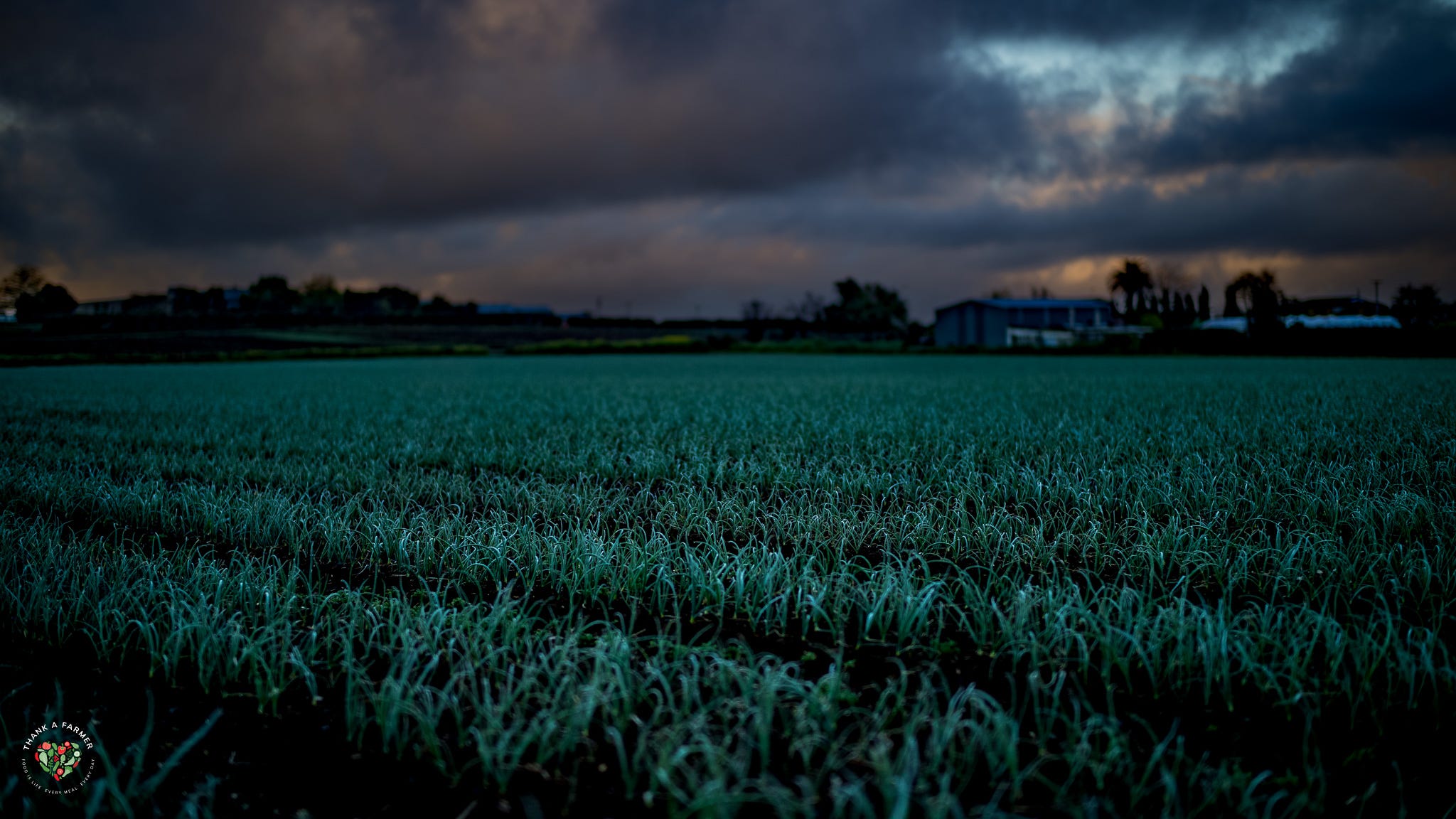
Pukekohe, spring 2026. A young onion crop under a gathering sky. In a few months, every bulb will be packed in a box with a grower’s name on it for a customer who wants to know exactly what’s inside.
In 2002, Balle Bros, the Pukekohe-based grower, packer and processor of New Zealand vegetables, became the first in New Zealand to gain EurepGAP certification for fruit and vegetables. EurepGAP is what GlobalGAP was called then. I was at Balle Bros at the time and did the work and the audits to get there. It was a great achievement, and the whole team put in the hard yards to make it happen.
It would not have happened if New Zealand had been growing GM onions.
What I remember most, not as vividly now as I did then, is how much New Zealand’s non-GMO status mattered. It has always stuck with me.
I’ve had 35-odd years in food and fibre, and GM has bubbled away in the background throughout. At Seminis Vegetable Seeds, I worked with the Crop & Food Research team at Lincoln as they developed a glyphosate-tolerant onion. In GlobalGAP audits, the grower had to account for the GMO status of every crop. Whenever I visited the companies that buy what New Zealand exports, the conversation eventually turned to GM. And I’ve lost count of the times I’ve explained to people, here and overseas, that New Zealand doesn’t grow GM crops.
The longer I spent in fresh fruit and vegetables, the clearer one thing became. Most people think about GM in fresh produce very differently from how they think about it in commodity crops. A GM soybean disappears into stock feed, and nobody gives it a second thought. An onion is something they pick up, turn over in their hand and put in the trolley.
Every New Zealand grower who exports fresh produce still has to answer for that difference. Our horticultural exports are certified under GLOBALG.A.P. or NZGAP, and both schemes require the grower to record the GMO status of what they grow and tell the customer. Nobody in Wellington wrote that rule. The customer did.
I keep coming back to that when I listen to how the gene technology debate is being put to New Zealanders. The arguments are serious, and the people making them are serious. But almost all of them are about crops we don’t grow, sold to buyers who never see them, and almost none of them have been put to the people who would carry the risk.
A word on the words
GM, GMO and GE all turn up in this piece, and in most conversations they’re used as if they mean the same thing. Mostly they do. The differences matter once a regulator, a certifier, or a customer is involved.
GM stands for genetic modification, changing an organism’s genes in a laboratory rather than through conventional breeding. A GMO, a genetically modified organism, is the plant, animal or microbe that results. GMO is the legal term. It’s the one in New Zealand’s HSNO Act, and the one most certification schemes and export customers write into their standards.
GE stands for genetic engineering. It describes the same thing from the perspective of the technique, and it’s the everyday term in New Zealand, which is why regions talk about being GE-free. For practical purposes, GE and GM are interchangeable. The Government prefers gene technology, the umbrella term in the Bill, which covers it all.
Where it gets slippery is gene editing. Tools such as CRISPR make targeted changes to a plant’s own DNA, often without leaving any foreign DNA behind. Since the 2014 High Court decision, New Zealand has regulated gene-edited organisms as GMOs. The European Union calls gene editing new genomic techniques and is giving some edits their own, lighter category. The trans-Tasman food standards body now asks whether novel DNA ends up in the food. The Forest Stewardship Council says CRISPR is GMO, whatever national law says.
So when I write GM or GMO, I mean it the way our customers do. Any organism whose genes have been changed in a laboratory, gene editing included. Non-GMO, the claim a grower puts on the box, means none of that has been used. The law may draw that line somewhere else. That gap is what this article is about.
How we got here
In 2001, a Royal Commission asked this country one question. What should New Zealand do about genetic modification? More than 10,000 people answered, at public meetings, at hui and in writing. The Commission’s own theme was “preserving opportunities”, and its answer has come down to us as “proceed with caution”. It also recommended a standing Bioethics Council to keep the conversation going as the science moved. That council was set up in 2002 and abolished in 2009.
Since then, the question has been answered in pieces, and most people never saw the pieces go past. In 2014, the High Court overturned an EPA attempt to exclude some gene editing methods from the rules. In 2018 the EPA ruled that organisms treated with dsRNA, the technology behind a new generation of gene-silencing sprays, are not genetically modified. In 2025, the trans-Tasman food standards body changed the test for what counts as GM food, from how it was made to what ends up in it. This year New Zealand’s national organic standard named gene silencing and genome editing as prohibited technologies from 2028.
Put the 2018 ruling next to the organic standard, and the problem becomes clear. Two regulatory regimes now apply different legal tests to the same technology. A dsRNA product can sit outside our GMO controls under HSNO and still be expressly prohibited in organic production. Neither decision was wrong on its own terms. Each answered a narrow question in a narrow forum. Nobody was ever asked to put the answers side by side, and the grower is the one left standing between them.
None of this appeared out of nowhere in 2026. BioGro has been certifying organic production in New Zealand since 1983 and has kept genetically modified organisms out of it the whole time. It also runs a Non-GMO verification programme that has nothing to do with organic. A conventional product with conventional ingredients can be independently verified as non-GMO. That programme exists because some customers want that assurance and are prepared to pay for it.
The Gene Technology Bill was the closest we came to asking the whole question again, and the way it was handled says a lot. MBIE’s Technical Advisory Group was already meeting by June 2024, alongside an Industry Focus Group and a Māori Focus Group. None of them had published terms of reference. The public heard about the reforms on 13 August. The Bill was introduced on 10 December with, in MBIE’s own words, no public consultation. Submissions closed on 17 February, two months later and across Christmas.
14,458 New Zealanders wrote in anyway.
Compare that with the way the same ministry reviewed plant variety rights a few years earlier. That process ran regional hui, brought in specialist advice on Māori and indigenous intellectual property, and published an issues paper, and then an options paper before a word of legislation was drafted. Even then, the Bill needed significant changes at select committee. That is what consultation is for. It finds the problems before they’re written into law.
Whether by design or by default, the effect is the same. Since 2001, New Zealanders have been asked narrower and narrower questions, with less and less time to answer.
The crops in the story aren’t ours
Listen to how the case for GM is made and notice which crops come up. Nearly every example is a commodity crop. In 2025, 99% of the world’s 216 million hectares of GM crops were soybean, maize, cotton or canola. In the United States, the biggest grower, around three-quarters of the soybean harvest and about two-thirds of the maize ends up as animal feed. Much of the rest of the maize goes into a fuel tank. Cotton becomes fibre. Canola becomes oil and meal.
Even Australia, the model our Bill was built on, tells the same story. The Gene Technology Regulator’s register lists 158 licences for releasing GM crops and plants into the environment over 25 years. 115 of them have since been surrendered, ceased or withdrawn. Of the 23 commercial crop licences still current, 18 are cotton or canola.
Two are fresh food, and I’d rather name them than have someone else do it for me. A banana bred to resist Panama disease was licensed in 2024. Nobody grows it commercially. The Australian Banana Growers’ Council says the industry can meet consumer demand without a GM variety, and treats it as a safety net if the disease gets out of control. A GM purple tomato, carrying genes from the snapdragon flower, was licensed in January this year and is due in Victorian fruit shops this spring. It has to be labelled as genetically modified. Its distributor has chosen high-end independent fruit shops over the supermarkets, and in his own words, “if you want to buy a Rolls-Royce, you go to a Rolls-Royce dealer”. The first GM whole fresh food grown in Australia is being sold as a niche product with a label on it, to customers who choose it. That tells you something about how its own backers read the fresh market.
It also tells you something about how these decisions reach New Zealand. The food approval for that tomato came through the same trans-Tasman standards body, and it covers New Zealand too. Growing it here would still need the EPA. Most New Zealanders have no idea the first GM fresh tomato is already approved as food on this side of the Tasman.
These crops are processed, blended, crushed or fed to stock. The person at the end of the chain never sees the plant. Nobody picks up a soybean in a supermarket and asks where it was grown.
Fresh fruit and vegetables are the opposite. They’re eaten whole. The variety is on the label, and often the grower and the country too. Before a carton leaves New Zealand it has been through an audit that asks what went into it. The customers at the other end are still asking. European retailers have been saying so in writing for two years. In September 2024, 376 food companies from 16 EU countries, including Rewe Group, dm and SPAR Austria, wrote to EU agriculture ministers asking for gene-edited food to be labelled and traceable. In May this year Rewe Group and dm wrote again, this time to the European Parliament’s environment committee, asking for the labelling and traceability to be put back and defending the right of retailers to sell “GMO- and NGT-free food”. NGT stands for new genomic techniques, the European Union’s term for gene editing.
This is why framing the debate as organic against conventional misses the point. I see a move towards more biological production as the sensible path, one that, over time, takes conventional growing as we know it towards biological and organic systems. Many of the growers I work with are interested. What holds them back for now is fear of whether they can grow that way commercially and viably. But organic or conventional, every one of them depends on being able to look a customer in the eye and say this crop is not genetically modified. The dividing line that matters to the market runs between GMO and non-GMO. Organic growers sit on one side of it, and so does every conventional grower selling on a non-GMO promise, verified or not.
In the year to June, MPI forecasts New Zealand’s horticultural exports at $9.47 billion.
Arable exports, the closest thing we have to a commodity crop sector, are forecast at $325 million.
Those two numbers are the whole debate in miniature. The global argument for GM is built on crops that end up in a feed trough. New Zealand’s biggest plant exports end up whole in a fruit bowl in Europe and Asia. We have borrowed the evidence from one and applied it to the other, and nobody has stopped to ask whether that holds.
Nobody has costed it either. MBIE’s own impact statement describes the costs to organic and non-GM producers as “unquantified”, while presenting the benefits as expected. The only estimate anyone has put on the table came from NZIER, commissioned by Organics Aotearoa New Zealand, which modelled scenarios where our primary sector exports fell by $10 billion to $20 billion a year. That work has been criticised, and it should be. Economic modelling ought to be challenged. But dismissing it is not the same as producing a better number, and the government hasn’t produced one.
I’ve spent a long time in rooms where one failed audit meant a grower’s season went with it. That is who carries this risk. Not the regulator, and not the company that owns the trait. The grower whose name is on the box. The one who planted in good faith, did everything right, and then finds out the rules changed somewhere they weren’t invited to.
And here is the question nobody has put to them. What happens when New Zealand law says something isn’t GMO, but the retailer, the certification scheme or the customer buying our food says it is?
When I hear the word coexistence, I think of putting myself in someone else’s shoes. Too often the buck stops with the grower. Real change is seldom a shared journey, and the people in the middle seldom want to share the risk. Talk is cheap. We’re hearing it right now with regenerative agriculture. Companies want to report hectares under regen and biological systems, but when the grower hits a hiccup along the way, they don’t want to share the pain of getting there.
So I’ll say plainly where I stand.
I’m against GM in fresh market fruit and vegetables, because I’ve sat in the audits and I know what our customers ask. For dairy, beef and lamb, I believe the answer is the same, and I’d want our exporters to show us the evidence either way. Where a GM crop can be kept completely apart from what we sell, and our customers are fine with it, I’m open. If we can’t keep them apart, I’m against it.
The best case against me
I’d rather deal with the strongest arguments than the easy ones, so here are three I hear from people I respect.
The first is that gene editing is just faster plant breeding. For some edits, that may be true in the lab. It isn’t how the market sees it. The European Union has just spent years loosening its rules on gene-edited plants, and the version it landed on this year still requires the seed to be labelled and keeps gene-edited products out of organic altogether. If the most important trading bloc for our premium produce draws that line after a long argument, our customers won’t wave the distinction away because a scientist in Wellington says they should.
Certification schemes are drawing the same line. In July this year, the Forest Stewardship Council published a formal interpretation saying CRISPR gene editing falls within its definition of a GMO, whatever an individual country’s law decides. FSC certifies forests, not food, so this isn’t about our produce. It shows that an international certification scheme can draw a stricter line than a national government and apply it to everyone it certifies. A government can decide a gene-edited organism isn’t legally a GMO. A customer or a certifier can still decide that it is.
The second is that other countries are moving ahead. Some are, and it’s worth looking at what they’re moving with. Japan has had a gene-edited tomato on sale since 2021. In the United States, the company behind the first gene-edited salad greens stopped marketing them in early 2024. The same purple tomato now coming to Australia has been sold in American supermarkets since 2024, grown in greenhouses and carrying a “bioengineered” label and a QR code. Its developer’s own figures put first-year sales at just over 100,000 punnets, through a handful of regional chains. It’s a real product, and it deserves to be taken seriously. It’s also a premium cherry tomato sold at home, with a label, to shoppers who choose it. Show me the fresh-market export success stories. There are very few.
The third is the one I take most seriously, because it comes from my own side of the argument. A gene-edited, disease-resistant potato could mean fewer fungicide sprays. I’ve spent years arguing for less chemistry, and different chemistry, sooner. So why wouldn’t I back it?
Because GM against more fungicide is a false choice. We’re at the start of a transition to a far more biological approach, and it’s much more than swapping a chemical fungicide for a biological one. It starts in the soil. You rebuild the soil biome into a thriving environment, so the plant can better ward off disease. The agronomy is far more detailed, and it asks for a can-do attitude and a different mindset. I won’t sugar-coat it. It will be challenging, and it won’t be a walk in the park. But it can be done.
We’ve also been down the GM potato road before. In the late 1990s, Monsanto sold NewLeaf potato on the promise of fewer sprays. McDonald’s, Wendy’s and Frito-Lay refused to use it, and it was pulled from the market in 2001. When Simplot’s blight-resistant GM potato came along years later, McDonald’s said plainly that it doesn’t source GMO potatoes. A potato nobody will buy doesn’t save a single spray.
You can’t take it back
This is the part I most want people to understand.
Parliament can repeal a law in an afternoon. It can’t recall pollen. Almost every other decision in this debate can be revisited if we get it wrong. Releasing a GM crop into the open can’t.
The United States learned this the hard way. StarLink corn was approved for animal feed only, because questions about allergies had never been settled. In September 2000, it turned up in taco shells, and more than 300 food products were pulled from shelves. The US government was still testing its corn supply for it ten years later, and StarLink was detected again in a shipment to Saudi Arabia in 2013. Six years after StarLink, traces of an unapproved GM rice turned up in the US commercial supply. US rice came off European shelves, and in 2011 Bayer settled with American rice farmers for US$750 million.
Both were commodity crops, with a feed-only approval in one case and trace amounts in the other. That is exactly the kind of coexistence we’re being promised.
Escaped crops outlast the fields they came from, too. Researchers surveyed roadside GM canola in North Dakota in 2010 and again in 2021, and it was still there eleven years on. To be fair to the study, the populations were shrinking, and some plants had lost their engineered traits. A customer’s test won’t care.
There’s a newer twist. Some gene edits leave no foreign DNA behind and may not be detectable by any test. That’s often put forward as reassurance. For a grower, it’s the opposite. If it can’t be found, it can’t be pulled from the supply, and it can’t be proven absent to a customer who asks.
Seed moves. Pollen moves. Machinery moves. People move. Coexistence is easy to promise politically. Delivering it biologically and commercially is much harder, and when it fails, the cost lands on the grower who never chose the technology. Proposed planning law changes may also take away regions’ power to declare themselves GE-free, removing the one form of separation we actually have, without saying what replaces it.
That is not a question about science. It’s a question about who pays.
Three questions, not one vote
One more cost comes with tangling all of this together, and it’s already landing.
Most of the new tools growers are waiting for have nothing to do with GM. Biologicals, microbials, biopesticides and newer, more selective chemistry all have to pass through the same approval gate at the EPA under HSNO before MPI can register them for use. On 24 September Parliament passed the ACVM Amendment Bill, which reforms the second step. The HSNO Amendment Bill, which reforms the first, stalled at the bottom of the Order Paper. Partly because it includes a power that GM-cautious groups object to. So the GM argument is now holding up crop protection that isn’t GM at all. We’ve widened the road into town and left the one-lane bridge at the start of it.
Parliament dissolved on 1 October, and the Gene Technology Bill lapsed with it. Whoever forms the next government will be asked about gene technology again, so here is what I’d ask them to do before any release is on the table:
Separate medicine and contained laboratory work from food and farming. They are different questions and deserve different answers.
Split the GM-related powers out of the HSNO Bill and let the rest through, so growers get the non-GM tools they’ve been waiting years for.
Put the fresh produce question to New Zealanders openly, with growers, exporters and their customers in the room. It has never been asked.
Prove that coexistence works before anything is released. How far apart, what level of seed purity, and who pays when it goes wrong?
Perhaps before we decide that the question has already been answered, we should actually ask it.
🌻
Thank a Farmer – Food is Life, Every Meal, Every Day

Sources
The personal experience in this piece, including Balle Bros,
Seminis, and the audits are my own. Everything else is listed below, in the
order it appears.
The Royal Commission and the Bioethics Council
Beehive, Report back of the Royal
Commission on Genetic Modification (30 July 2001)
Royal Commission on Genetic
Modification (summary,
including submission numbers)
Toi te Taiao: the Bioethics
Council
(established 2002, disestablished 2009)
How the definition moved
High Court, Sustainability Council of
New Zealand Trust v Environmental Protection Authority [2014] NZHC 1067
EPA, determination APP203395
(dsRNA-treated organisms, 2018, reissued 2021)
FSANZ, Proposal P1055: definitions
for gene technology and new breeding techniques (gazetted 2 September 2025)
Organic Standards
Regulations 2025 (SL 2025/197), regulation 12
MPI, Organic Notice:
Operators 2026 (made 10 August 2026, in force 31 March 2028), clause 1.2
BioGro
BioGro, Non-GMO verification
programme
BioGro, About BioGro (certifying since 1983)
The Gene Technology Bill
MBIE, Regulatory Impact
Statement: Reform of Gene Technology Regulation (31 July 2024)
MBIE, Regulation of Gene
Technologies: Policy Decisions (Cabinet paper)
MBIE, Gene Technology Bill:
Approval for Introduction (introduction 10 December 2024)
MBIE, Gene technology regulation (advisory and focus groups)
Technical Advisory Group terms of reference, released under the
Official Information Act, 17 December 2024 (DOIA REQ 0006620)
Scoop, Gene Technology Bill:
submissions received and schedule of hearings (14,458 submissions)
MBIE, Plant Variety Rights Act
1987 review (issues
paper, options paper, hui)
Commodity crops and Australia
AgbioInvestor, Global GM Crop Area Review (May 2026, 2025 season)
USDA Economic Research Service, Oil Crops Yearbook (US soybean use, 2022 to 2025)
USDA Economic Research Service, Feed Grains Sector at a
Glance (US corn
use, including exports for feed and distillers grains, 2022 to 2025)
Office of the Gene Technology Regulator, Dealings involving
intentional release (licence register) (checked 30 September 2026)
Australian Banana Growers’ Council, FAQ: GM bananas
ABC News, Growers fight to save
Cavendish bananas as farms fall to Panama disease (2 September 2026)
ABC News, Genetically modified purple
tomatoes bound for fruit shops after regulator approval (30 January 2026)
FreshPlaza, If everything goes to plan,
Purple Bliss tomatoes will be in Victorian fruit shops in spring (3 March 2026)
FSANZ, A1333: food derived from
purple tomato lines (applies
in Australia and New Zealand)
Fresh produce, customers and exports
Horticulture New Zealand, Submission on the Gene
Technology Bill (17
February 2025, GLOBALG.A.P. and NZGAP GMO status)
dm-drogerie markt, Open letter to EU
agriculture ministers on labelling of new genetic engineering (September 2024, 376 companies)
European retailers, Letter to members of the
European Parliament’s Environment Committee (4 May 2026)
MPI, Situation and Outlook for
Primary Industries (June 2026
forecasts)
Organics Aotearoa New Zealand, NZ exports risk
multi-billion dollar hit if GMO rules deregulated (NZIER modelling, 26 November 2024)
The best case against me
Council of the EU, New genomic techniques:
Council adopts new rules (21 April
2026)
Forest Stewardship Council, New interpretation on the
definition of GMOs published (20 July 2026)
Nature Biotechnology, GABA-enriched tomato is
first CRISPR-edited food to enter market
FoodNavigator-USA, Pairwise stops marketing
gene-edited Conscious Greens (13 February 2024)
Norfolk Healthy Produce, Commercializing the
Bioengineered Purple Tomato (AEIC, spring 2025, US sales figures)
The Packer, Are consumers finally ready
to embrace GMOs in the produce aisle? (bioengineered label and QR code)
PotatoPro, The history and future of
GM potatoes (NewLeaf)
CBS News, McDonald’s says no to GMO
potato (November
2014)
Modern Farmer, USDA approves genetically
modified potatoes that can resist blight (November 2016)
You can’t take it back
Congressional Research Service, StarLink corn controversy:
background
StarLink corn recall (including 2013 detection)
farmdoc daily, $750 million settlement in
GM rice contamination (July 2011)
ScienceDaily, Escaped GMO canola plants
persist long-term, but may be losing their extra genes (PLOS ONE, May 2024)
NZ Herald, Northland Regional Council
slams Gene Technology Bill’s threat to GMO-protected zone
The approval pipeline
Fenton Hazelwood, Half a Fix (Thank a Farmer, 27 September 2026)
Organics Aotearoa New Zealand, Three Bills, One Big Picture (June 2026)
Farmers Weekly, Gene Technology Bill
unlikely to pass this term: Peters (June 2026)
Fenton, this is another outstanding piece of work — and I feel it is vital for all New Zealanders to understand and have a voice on, as it will determine every New Zealanders future.
What stands out to me most is that you aren't simply arguing against GM or gene technology. You are asking a much more fundamental question:
Who carries the risk when things go wrong?
And your answer is very clear — again it is the GROWER.
The person whose name is on the box and as New Zealanders we need to acknowledge this.
You bring a high level of real-world experience to this discussion and you understand something that seems to be missing from much of the political debate: what governments decide is acceptable, isn't necessarily what our customers will accept.
I feel that distinction is so important as our fresh-produce industry has built a reputation around trust, traceability and being able to tell overseas customers exactly what they are buying.
As you point out, the crops used to promote the benefits of GM technology globally are overwhelmingly commodity crops — soy, maize, cotton and canola — whereas much of New Zealand's horticultural production ends up being eaten whole, with the grower, variety and country of origin visible to the customer.
That is a very different proposition.
And I think one of the most concerning points you make is that New Zealand has never actually asked its fresh-produce growers the question that matters most to them.
Instead, we have had a succession of narrower regulatory decisions, changes in definitions and a Gene Technology Bill developed without the sort of broad public consultation that such a fundamental change arguably deserves. Even without public consultation 14,458 New Zealanders took the opportunity to make submissions, so imagine the numbers if we were given the opportunity.
Then there is the issue of coexistence.
It is very easy to use that word in a policy document.
But pollen doesn't read policy documents.
Seeds move. Machinery moves. People move. And once something has been released into the environment, we can't simply pass another law and put it back in the bottle.
That is probably the single biggest issue for me.
A mistake in regulation can be corrected. A mistake released into the environment can not be.
You ask the question that seems to be missing from much of the debate:
Show us that it will actually work for New Zealand's fresh-produce export market before we take the irreversible step.
You are bringing the discussion out of the political and scientific bubble and back to the people who actually have to live with the consequences.
The growers.
The exporters.
The consumers.
And ultimately, all of us who depend on New Zealand maintaining the trust and reputation that our primary industries have spent GENERATIONS building.
Thank you for continuing to do the digging, asking the uncomfortable questions and, most importantly, putting the evidence in front of everyday New Zealanders.
Most of us simply don't have the tenacity or determination to work through legislation, regulatory decisions, certification standards and international markets to understand what is really happening.
Keep asking the questions, Fenton. New Zealand needs more people willing to do exactly that.
You have made this your priority and I feel its your purpose - thank you - momentum is building.
A timely, well researched and balanced article Fenton. Everyone involved in the decision making process with regards to GM/GE needs to read and understand this piece. There is no returning the genie into the bottle once it is released onto the NZ environment. (And I used the word onto deliberately). I personally and professionally as an Agronomist think that it would be a massive mistake and a long term death sentence for the NZ brand.