


What you’re meant to see.
On a Sunday in May I stood in the freezer aisle at Pak’nSave Royal Oak, buying frozen peas and sweetcorn and photographing the backs of the bags.
I was pleased, to be honest. There was a New Zealand grown option for both. The corn was Talley’s, with a Marlborough farm named on the pack. Next to it sat McCain Super Juicy Corn Kernels: “Packed in New Zealand using Corn Grown in China.”
The McCain peas a few freezer doors along listed the same company and the same Timaru address as the corn, yet one was grown here, and the other wasn’t. The bag looked the same. The brand looked the same. Only one line of small print had changed.
When it’s grown here, it says so on the front. Talley’s puts “100% NZ GROWN” in a big badge on the front of the bag. When it isn’t, you’ll find it on the back.
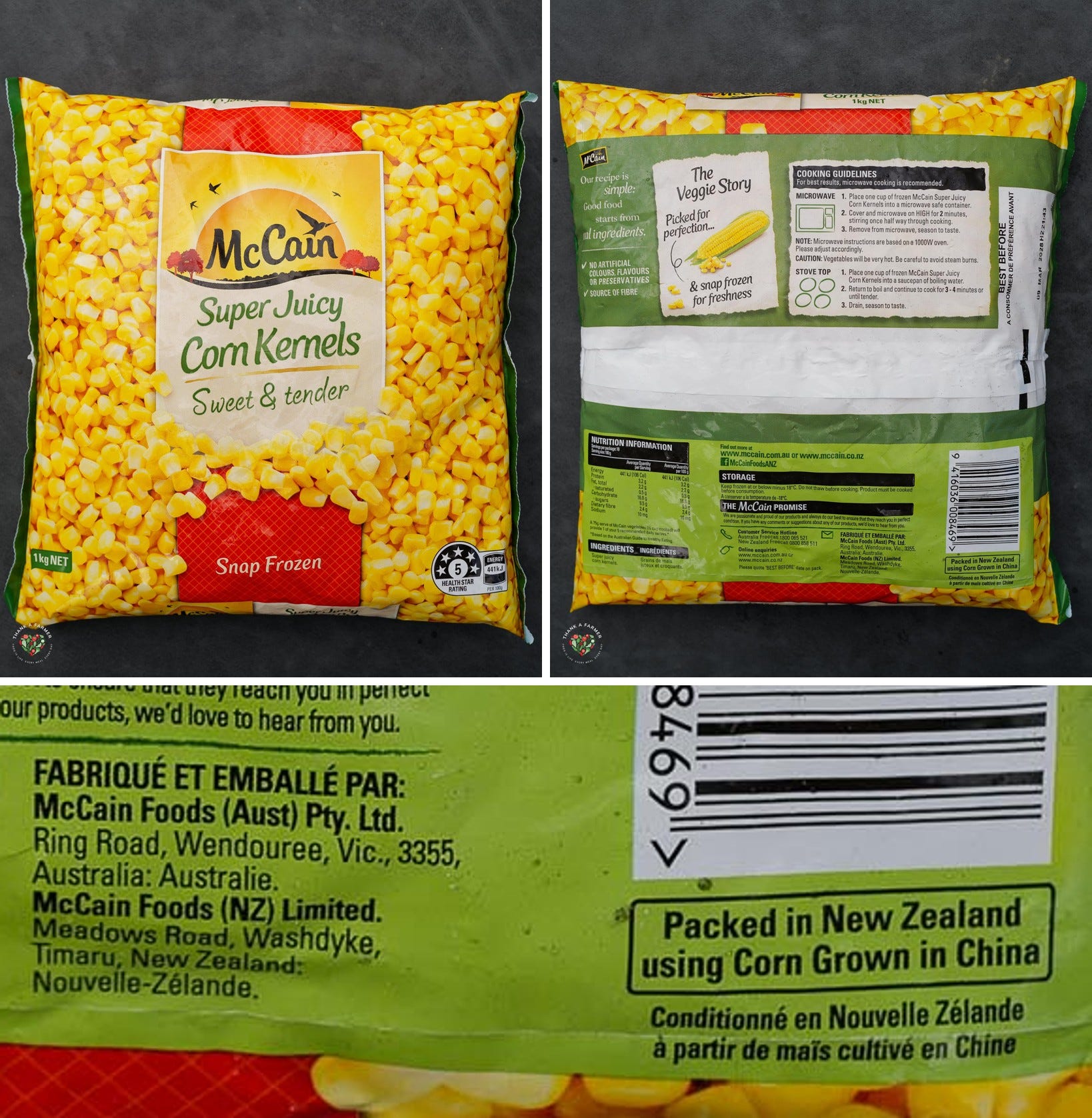
Front: a farm, a sunrise, “Super Juicy”. Back, bottom corner: “Packed in New Zealand using Corn Grown in China.”
That afternoon I went to New World Mt Roskill and Woolworths Grey Lynn, all within about five kilometres of each other. Neither stocked any New Zealand-grown sweetcorn.
I was stunned. I’m not naive about where our food comes from. But I never thought it had reached the point where a shopper couldn’t choose New Zealand grown, even if they wanted to.
That Sunday has stayed with me, because it is the whole story in miniature. What’s on the front of the pack is what you’re meant to see. What’s on the back is what’s true. And for most of what decides whether New Zealand can keep feeding itself, there is no back of the pack to read.
The front of the pack
Over the past few weeks, supermarkets have told us a lot.
Foodstuffs says it earns about three cents in the dollar. It says more than 70% of Pams sales are made in or sourced from New Zealand. This week Chris Quin, chief executive of Foodstuffs North Island, posted a graphic of thirty-odd grocery logos, from supermarkets to butchers to delivery apps, under the line “we see more and more competition.”
Each of those statements can be defended. I want to be fair about that. None of them is a lie.
But each one is a front of the pack. The three cents is one measure chosen from several, and Foodstuffs’ own economists told the Commerce Commission in 2021 that margins like this can’t be compared without adjustment. The 70% is counted by volume, not value, and includes cleaning products. The logo graphic leaves out the number that matters most: Foodstuffs and Woolworths still take 82 cents of every grocery dollar in this country, according to the Commerce Commission’s own figures.
The back of the pack
Here is what nobody can currently read.
How much the owner-operators of Foodstuffs’ 500-odd stores earn. Their co-op accounts say plainly that they don’t include member stores, and the stores are where the money lands.
What share of a dollar spent on vegetables reaches the grower? The last serious attempt to measure it, NZIER’s 2019 study, put it at about 16 cents, before the grower pays for seed, fertiliser, labour, fuel, or anything else. Nobody has published a figure since.
Whether growers are making a living. HortNZ counted more than 7,000 fruit and vegetable growers in 2005 and around 4,300 today. Over the same period, the area used for horticulture grew. Far fewer businesses farm the land. That could be efficiency. It could be people walking away from land that no longer pays. We don’t measure grower returns, so nobody can tell you which.
What a grower is paid this week compared with last. When I started out, in food and fibre, there was a daily market. Everyone could see where the price sat. Today most fresh produce is priced privately, grower by grower, and the buyer sees every price while the grower sees one.
This isn’t a story about whether supermarkets make too much money. It’s a story about whether anyone can tell.
New Zealand lacks enough transparency to know whether the economic system supplying its domestic food is sustainable. And if we can’t tell whether the people growing our food can keep doing it, we can’t tell whether New Zealand can keep feeding itself.
Where I stand
I’m not against supermarkets, and I’m not against profit. Supermarkets do difficult things well. Full shelves every morning, cold chains that run the length of the country, systems that know what sold in every store yesterday. Dr Hans Maurer, who ran produce for Foodtown, has been making that case in a series of articles this spring, and he is right that breaking things is easier than rebuilding them.
I also know markets are rarely perfectly fair, and the costs that squeeze growers come from many directions, including the inputs they buy. Some of those inputs are sold by the business I work for.
What I am arguing is simpler. A market works when both sides can see it. When the buyer can see everything and the seller can see almost nothing, supply and demand stops being a market and becomes a decision made by one side. New Zealand has drifted into that position in fresh food, and we have done it without measuring what it is costing us.
If fair scrutiny of the full numbers showed that supermarket profits were not excessive, I would accept that and say so. Then I would turn my attention to the harder question: whether the growers feeding five million people can keep doing it. Either way, we need the numbers.
What comes next
Over the next three weeks I’ll take the supermarket messaging one claim at a time and set it against what’s on the back of the pack. The three cents. The 68 cents that “goes to suppliers”. The Pams 70%. What has happened to our growers? What happened to the price everyone used to see? How to read the next good-news post for yourself.
For each one, I’ll ask four plain questions. Is it transparent? Is it honest, or just technically true? Who feels owed what? And who answers for it?
After the election, I’ll set out what I think should change. It won’t be price controls or a break-up. It will be numbers.
On Wednesday, piece 2: Which 3%? Foodstuffs has published three different profit figures. Each one is smaller than the last.
Next time you shop, turn a bag over. Send me what you find, or show the person you shop with.
In November I’m doing the freezer aisle again, same three stores. The fronts will look much the same. I’ll be reading the backs.
I work in key account management and business development for WestAg, a grower-owned reseller that supplies growers. My living depends on growers staying in business. That is part of why I care, and you should read what I write with that in mind. For more than thirty years, I have told growers what is best for them, even when the company I worked for didn’t sell it. Hold me to that standard here too.
Thank a Farmer - Food is Life, Every Meal, Every Day
🌻

Sources
You can check every figure in this piece. Where a source is my own observation, I say so.
The freezer aisle, 3 May 2026: my own shop and photos, first written up in Same Factory. Two Countries. (Thank a Farmer, 4 May 2026).
“About three cents”: Chris Quin, 3.6c after tax “across our supermarket”, Newstalk ZB and NZ Herald, August 2025. HoustonKemp’s 2.3%, commissioned by Foodstuffs, 1News, 4 October 2026.
Pams 70%, by sales volume, and the cleaning-products supplier: Foodstuffs, Behind the Pams brand, there’s a whole lot of New Zealand, 7 October 2026 (same article on the South Island newsroom).
The logo graphic: Chris Quin, Growing choices for customers is important, LinkedIn, 14 October 2026.
Foodstuffs’ own economists: Incenta for Foodstuffs, Measuring profitability for the grocery retailers, submitted to the Commerce Commission, December 2021.
82% of grocery sales to Foodstuffs and Woolworths: Commerce Commission, 2025 Annual Grocery Report, 2 June 2026, page 1.
Store numbers: Foodstuffs North Island (”300 stores”) and Foodstuffs South Island (”more than 200 stores”), websites, October 2026. Member stores outside the co-op accounts: Foodstuffs North Island annual reports.
About 16 cents to vegetable growers: NZIER for Federated Farmers and HortNZ, August 2019, filed with the Commerce Commission as HortNZ submission, Attachment 4, February 2021.
More than 7,000 growers to around 4,300, while the growing area increased: Horticulture New Zealand, HortNZ marks 20 years supporting one of New Zealand’s fastest-growing sectors, 10 December 2025.
The daily market: my own experience.
Dr Hans Maurer: LinkedIn articles, August to October 2026, including The Council of Wonders (21 September 2026).
Another really good piece, Fenton, that we have just listened to while driving from Hamilton back north. What struck me most is how easily we can be given a reassuring picture of what's happening, without seeing the bigger picture or asking what we're not being told.
The example of the frozen vegetables really brings it home. You'd think that in New Zealand we'd be able to choose locally grown produce if we wanted to woth ease, but apparently that's not always the case. And the more I think about it, the more concerning that becomes.
What's really important is whether the people growing our food can actually make a living, and whether we're paying enough attention to what happens if they can't.
As you say once growers walk away and production disappears, we can't just flick a switch and get it back.
I also think your point about transparency is vital. If the numbers are fair and the system is working, surely there should be nothing to fear from opening the books and letting growers see the whole picture.
We all rely on a secure food supply, yet most of us give very little thought to what sits behind the supermarket shelves. Thanks for making us look a little closer, Fenton. I'll certainly be turning a few more packets over from now on!