

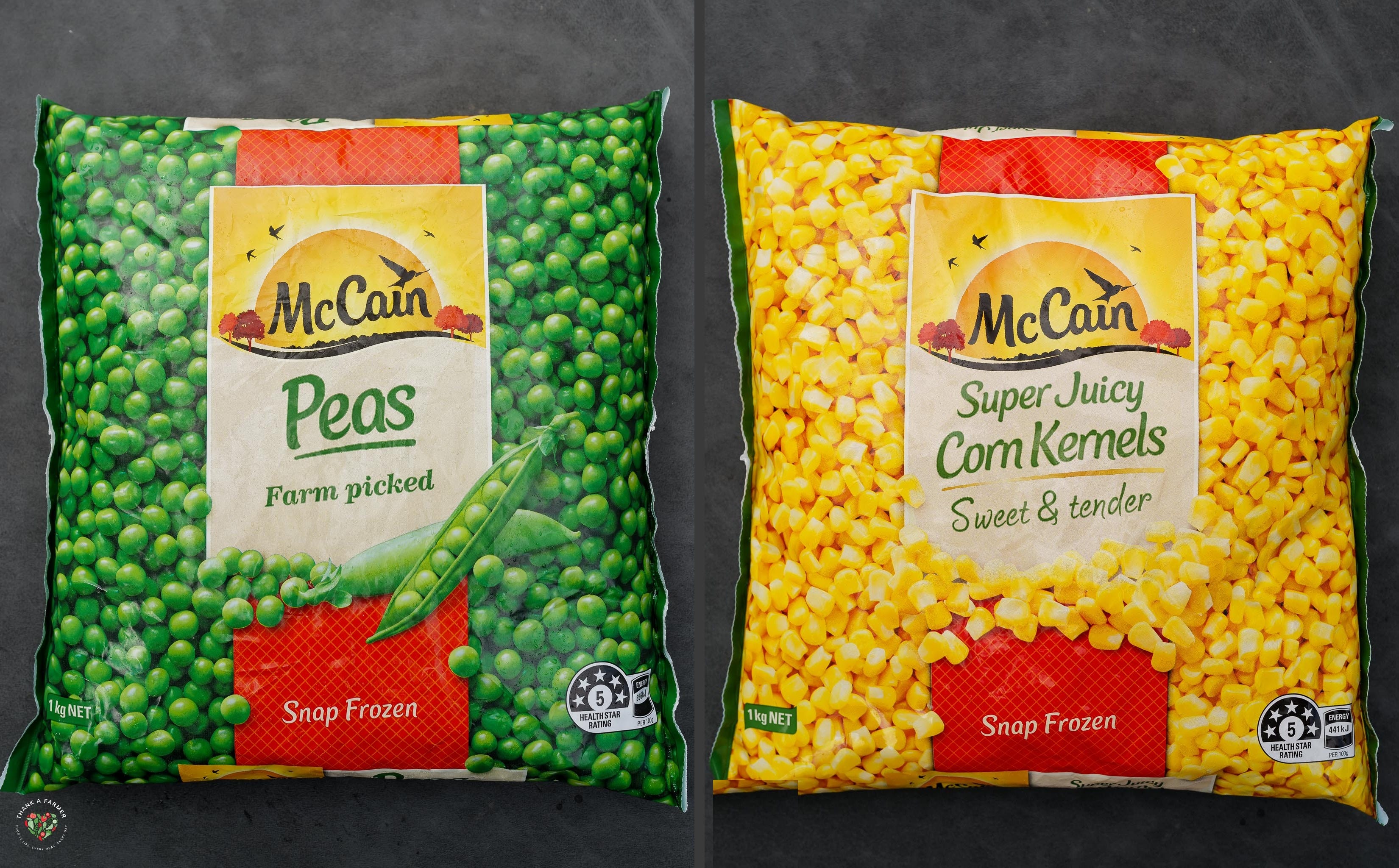
One of these was grown in New Zealand.
Two bags from the same freezer.
Same brand. Same sunrise logo. Same red band down the middle. Same “Snap Frozen” at the bottom. One is peas, one is corn. From the front, that is the only difference you can see.
Turn them over.
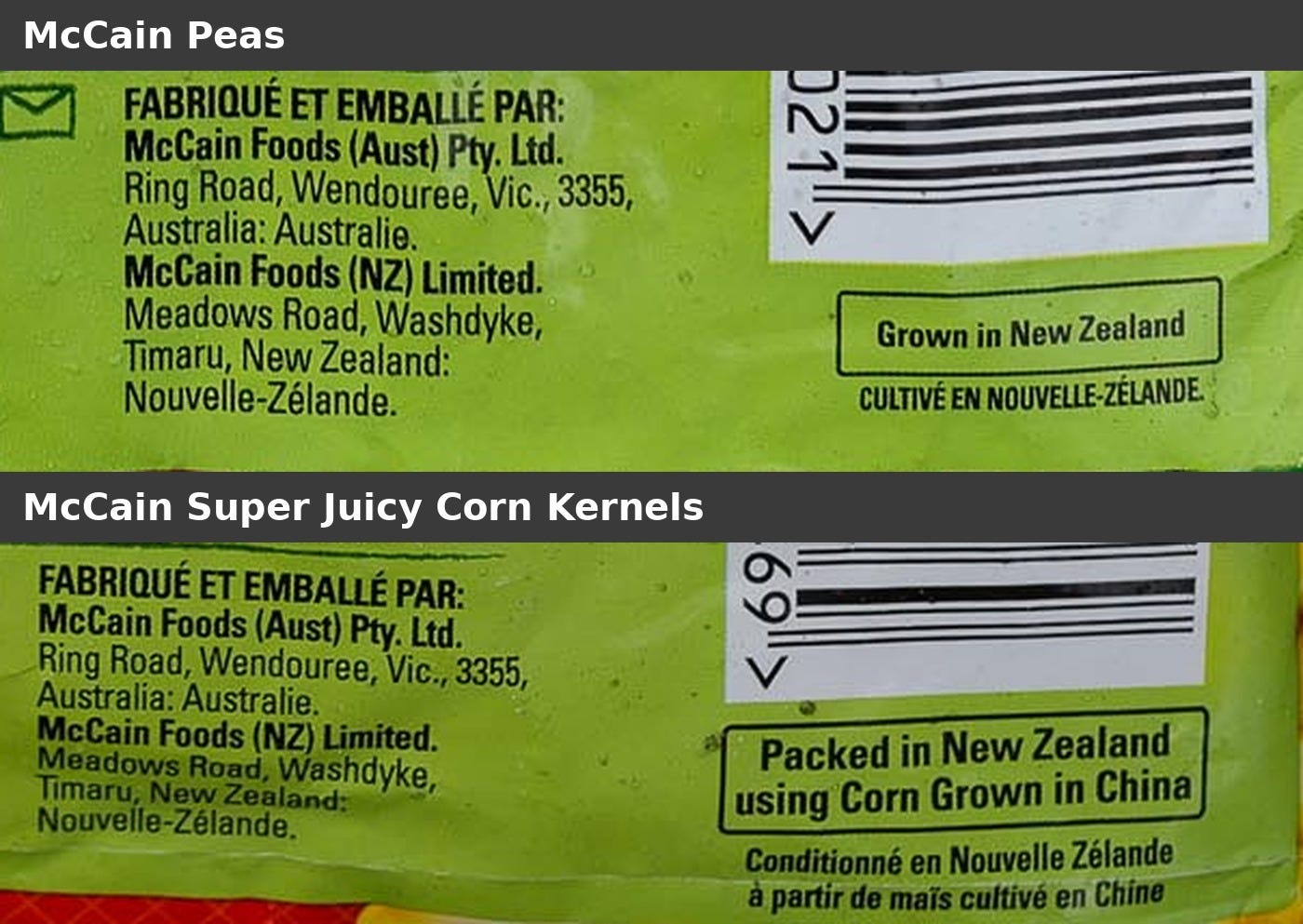
The peas say “Grown in New Zealand.”
The corn says “Packed in New Zealand using Corn Grown in China.”
Both labels are true. Both are legal. And you only find out which is which if you stand in the freezer aisle with the door open and read the small print on the back of every bag.
In the first piece of this series I said the front of the pack is what a company wants you to see, and the back is where the truth lives. That was one bag. This piece is the whole aisle.
The corn you couldn’t buy
That shop was on Sunday 3 May. Three Auckland supermarkets, one afternoon.
At Pak’nSave Royal Oak there were two choices. McCain corn, grown in China, at $5.99. Talley’s corn, grown in Marlborough with the farm pictured on the back, at $6.99.
In that store, the New Zealand corn was a dollar dearer.
But at New World Mt Roskill that afternoon, the Chinese corn cost $6.99. Exactly what the New Zealand corn cost at Pak’nSave. At New World and Woolworths, no New Zealand-grown corn was on the shelf at all.
The problem that day wasn’t price. You couldn’t buy it at any price.
The peas told a better story. Every bag of peas on all three receipts was New Zealand grown, and in every store the cheapest bag was the supermarket’s own brand. Pams Minted at $3.19. Pams Garden at $3.49. Woolworths Minted at $3.50. Credit where it’s due. Local was the cheap option.
Hold onto that. It matters later.
Mix them, and the rule goes away
The McCain corn bag only tells you about China because the law makes it.
Our origin rules cover fruit and vegetables “of a single type.” The Commerce Commission’s own guidance gives the example of what falls outside: “they do not apply to packets of mixed peas and corn.”
Tip the same corn into a bag with some peas and carrots, and nobody has to tell you where any of it was grown.
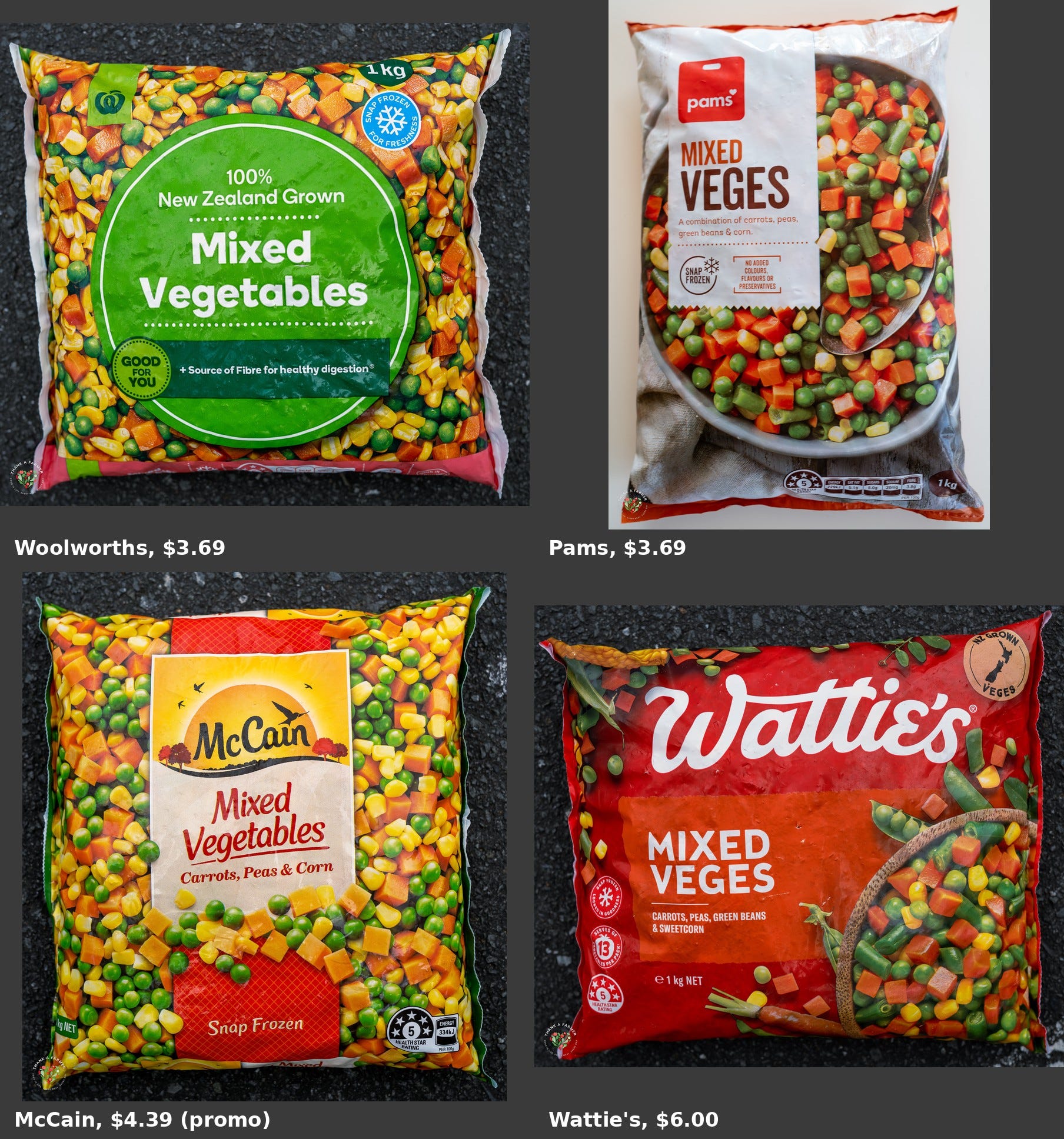
So this weekend I went back to the freezer. Four bags of mixed vegetables, two supermarkets, two days.
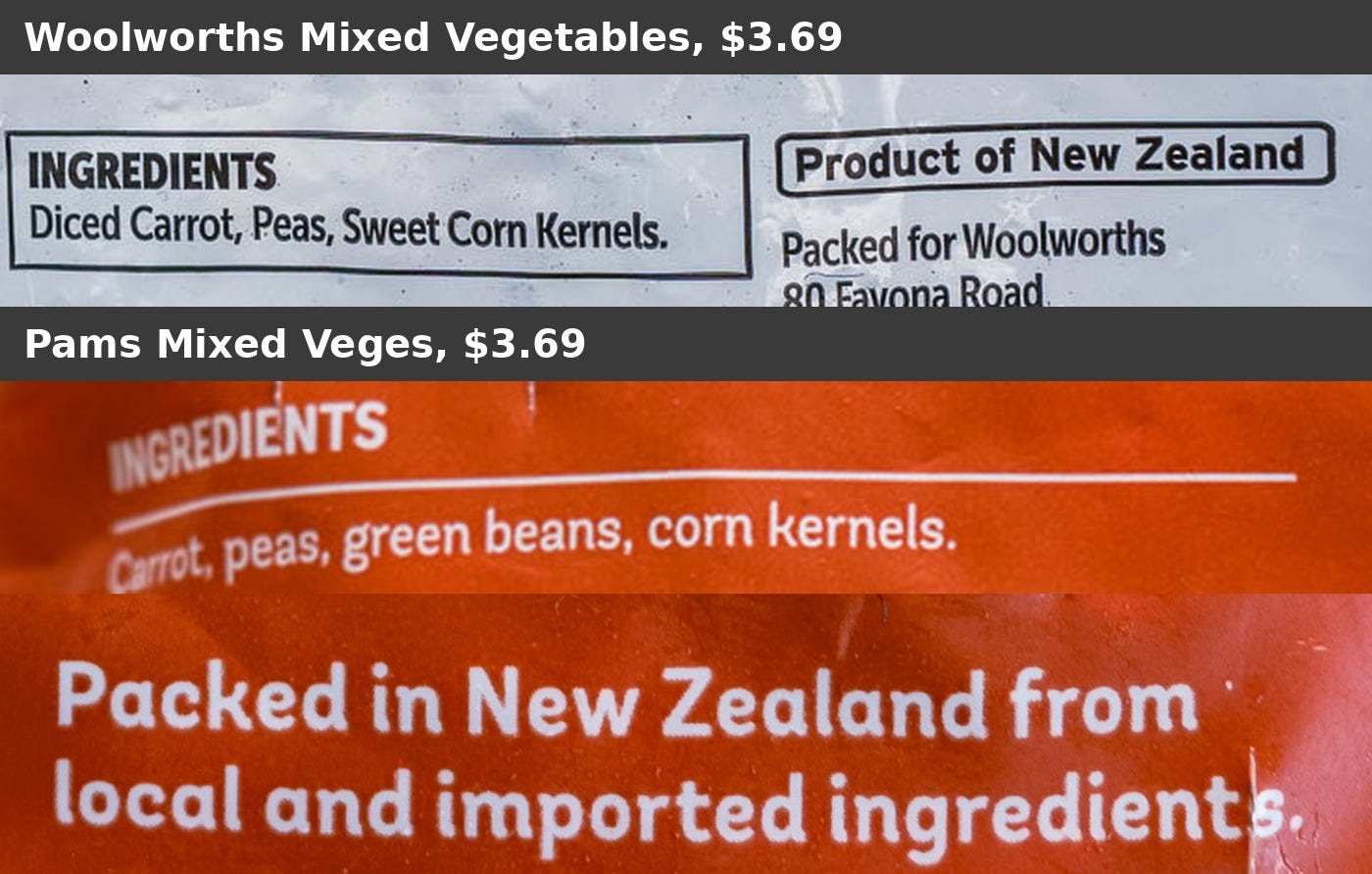
Pams Mixed Veggies, from a New World on Sunday 25 October. $3.69. Nothing on the front about where it was grown. On the back: “Packed in New Zealand from local and imported ingredients.” Carrots, peas, green beans and corn. It doesn’t say which.
Woolworths Mixed Vegetables, from Woolworths Katikati on Monday 26 October. $3.69. On the front, in big type: “100% New Zealand Grown.” On the back: “Product of New Zealand.”
McCain Mixed Vegetables, same store. $4.39 on promotion. Nothing on the front. On the back: “Grown in New Zealand.”
Wattie’s Mixed Veggies, same store. $6.00. “NZ Grown Veges” on the front, “Grown in New Zealand” on the back.
Three of the four told you they were New Zealand grown without being made to. Woolworths put it on the front in letters you could read from the end of the aisle. The rules didn’t ask for that. They did it anyway, and they did it at $3.69. That deserves saying plainly. It proves a mixed bag can carry an honest origin label at the lowest price on the shelf.
I’ll admit what surprised me. The Australian-owned chain’s bag said 100% New Zealand grown. The New Zealand-owned co-op’s bag said local and imported. I didn’t expect it to fall that way round.
Pams may well have used New Zealand vegetables in that bag. I don’t know, and that is exactly the point. “Local and imported” covers whatever went in this season. The shopper can’t tell, and neither can I.
And McCain? Its bag of corn says grown in China. Its mixed bag, with corn in it, says grown in New Zealand. Same company, same Timaru address, same design. I’m not going to guess why. I’m telling you what the two labels say. If you learned in May that McCain corn comes from China, you’d be wrong about this bag. If you learned today that McCain mixed vegetables are grown here, you’d be wrong about the corn.
Seven ways to say it
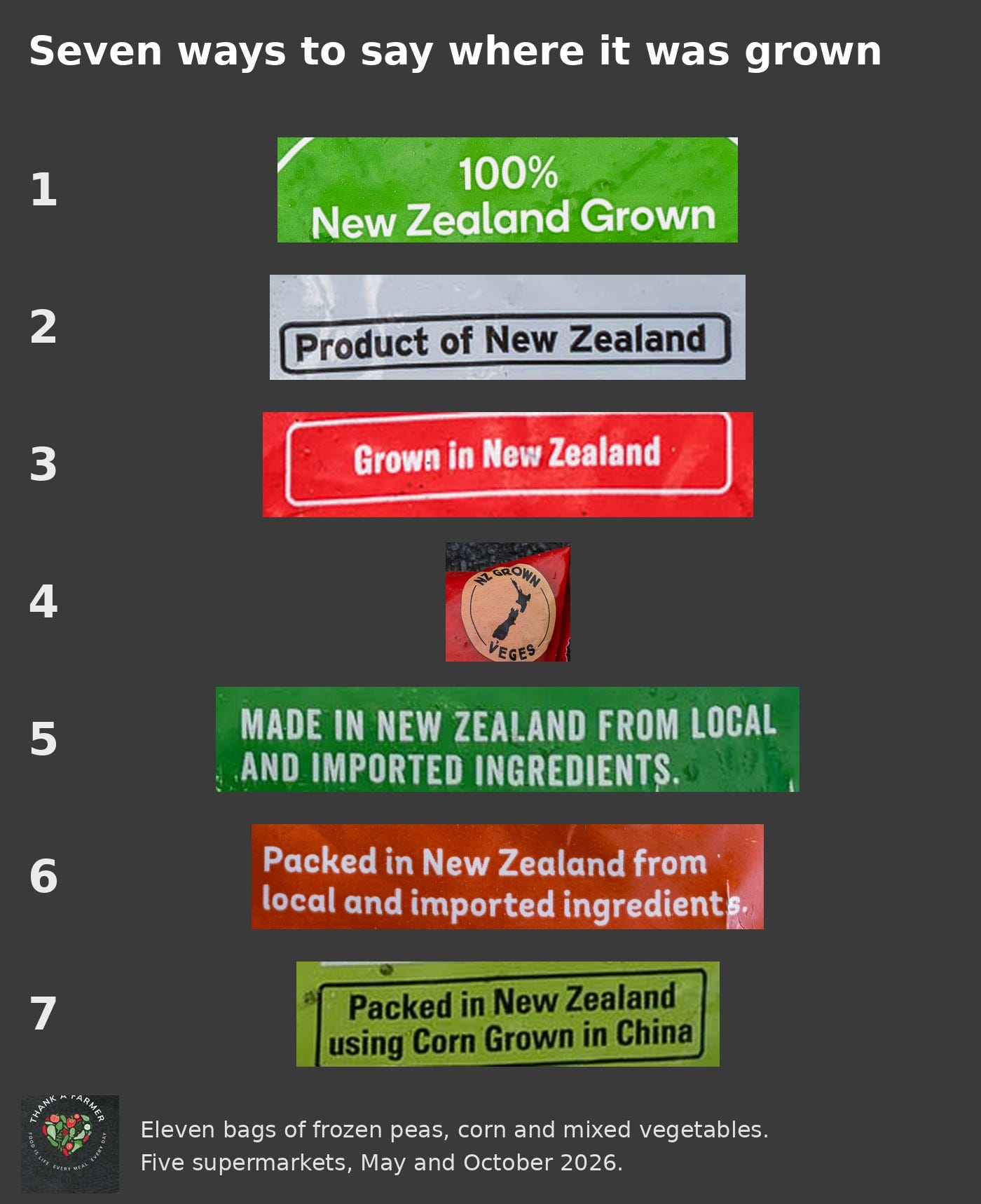
Across the eleven bags I’ve photographed since May, I’ve counted seven different ways to say where the food came from.
“100% New Zealand Grown.” “Product of New Zealand.” “Grown in New Zealand.” “NZ Grown Veggies.” “Made in New Zealand from local and imported ingredients.” “Packed in New Zealand from local and imported ingredients.” “Packed in New Zealand using Corn Grown in China.”
A shopper needs a dictionary to buy a bag of peas.
The price won’t help either. The New Zealand-grown mixes cost $3.69, $4.39 and $6.00. The one with imports costs $3.69.
The gap isn’t that everyone is hiding something. Most of these bags were open with me. The gap is that the rules leave it to each brand to decide how much to say, so a confident label and a vague one sit side by side at the same price, and only the fine print tells them apart.
That isn’t honesty. It’s luck.
“Made in or sourced from”
On 7 October, Foodstuffs published a piece called “Behind the Pams brand, there’s a whole lot of New Zealand.” It says “more than 70% of Pams sales come from products made in or sourced from New Zealand.”
Read those four words again. Made in or sourced from.
A bag packed in New Zealand from imported vegetables is made in New Zealand. So the 70% can be true, every word of it, and still not tell you how much of it was grown here. The release doesn’t say, and nothing makes it say.
The same release says around 26% of Pams sales come from overseas for products that “can’t be produced here, such as rice and pasta.”
Rice, fair enough.
Pasta is produced here. Monty and Sons in Martinborough make dried pasta from two ingredients, New Zealand-grown durum wheat and water. The Wairarapa Grains Collective grows and mills the durum in the Wairarapa, on farms at Kahutara, Gladstone, East Taratahi and Te Ore Ore.
In May, their radiatori won Supreme Champion at the Outstanding NZ Food Producer Awards. The head judge, Peter Gordon, praised its “delicious nuttiness” and its “fantastic light ‘chew’.”
It’s small. Nobody is pretending it could fill a supermarket aisle tomorrow.
But “can’t” and “doesn’t yet” are different words. One closes the door. The other asks why nobody has walked through it.
Passing the test isn’t meeting the standard
Imported food must meet our food safety rules and residue limits. Good. That test matters.
It doesn’t ask how the food was grown.
Pork is the clearest case. On 4 December 2015, New Zealand ended the routine use of sow stalls during pregnancy. NZPork says almost two-thirds of the pork we eat comes from overseas. In 2022, more than 50,000 tonnes came in, and around 40,000 tonnes came from Spain, Germany, Poland, Canada, Finland and the United States. In each of those countries, NZPork says, sows can still be confined in stalls during pregnancy, a practice New Zealand stopped in 2015.
That pork can be cured here, packed here, carry a big “Made in New Zealand” on the front, and put the country the pig was raised in on the back, in type as small as the printer likes.
The rule for cured pork, Regulation 10, asks only that origin be “clear and legible.” Nothing about size. Nothing about where on the pack.
In July 2023, Parliament’s Regulations Review Committee upheld NZPork’s complaint and said that combination could be “materially confusing or misleading.” This September the Minister declined to change the rule. He said he is “not aware of evidence that this is occurring on a scale that would justify further regulatory change.”
The pack passes the test. It doesn’t meet the standard we hold our own farmers to. A residue test can’t see a sow stall. It can’t see the conditions of the people who picked the crop either. Tearfund has warned that without modern slavery laws, New Zealand “runs the risk of becoming a dumping ground” for food made in those conditions.
None of that shows up on the back of the pack.
The same standard for everyone
Reciprocity cuts both ways, so here is the part our Food and Fibre side may not enjoy.
When Parliament considered country-of-origin labelling, the Food and Grocery Council opposed the bill in its original form. So did Fonterra. So did Federated Farmers. The worries were compliance costs and our trading position.
Farmers resisted labels too. I won’t pretend otherwise.
However, New Zealand earns its living asking the rest of the world to trust a label. “Made in New Zealand” on a block of butter in Shanghai or a lamb rack in London is worth money because buyers believe it means something. We ask them for that trust every day. Asking the same of what comes into our own freezers isn’t protectionism. It’s reciprocity.
Across the Tasman, that same bag of mixed vegetables would have to show what share of it was grown in Australia. Here it can say “local and imported” and stop.
Fresh is not the same as fed
On my first piece, several readers raised food sovereignty without me prompting it. So let me name it properly.
The term comes from the international farmers’ movement that coined it in Mali in 2007, and some of the politics that came with it aren’t mine. The idea underneath it is simple, and I’d put it this way. Food sovereignty is a country’s ability to grow its own food, and the right to know where the rest comes from.
Food security asks whether there’s food on the shelf. Food sovereignty asks whether we could still put it there ourselves.
We’re often told New Zealand grows 99.4% of its own fresh vegetables. That figure comes from United Fresh, and to its credit, the same paper explains what it leaves out. It “does not account for the proportion of domestic fresh produce replaced by imported processed products.” It also says “New Zealand lacks consistent tracking of, and/or public availability of production volume data, across all relevant sectors.” Fresh is the part we measure. The freezer is the part we don’t.
That freezer is changing. Wattie’s frozen peas are set to leave the shelf. Around 220 Canterbury growers produce roughly 36,000 tonnes of peas a year for those lines. Supermarkets already buy canned and frozen vegetables for their own brands from China, South Africa, Thailand and Italy.
Turn over a bag of Wattie’s peas, and you’ll find this printed on the back:
“In 1934 Sir James Wattie had a vision to capture the goodness of fruit and vegetables at their peak from around New Zealand. Thanks to his foresight, we can still enjoy Wattie’s ‘Pick of the Crop’ any time of year.”
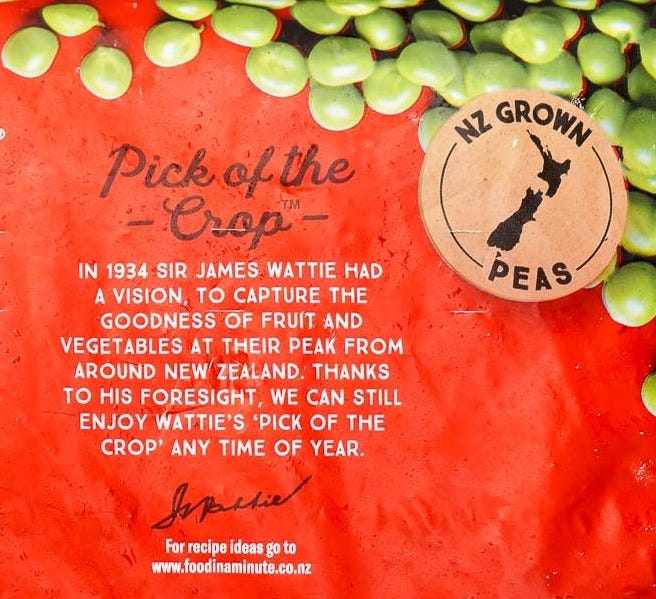
I’ll leave that there.
A label is only as good as the paddock
Back to the $3.19 bag of peas. Local was the cheap option in May. What goes into that bag when the paddocks that filled it are planted in something else?
The Woolworths mixed vegetables say “100% New Zealand Grown.” I hope they still can next year. The McCain mix says “Grown in New Zealand.” I hope that holds too.
Neither depends on the printer. Both depend on growers staying in business, processors staying here to freeze what they grow, and shoppers being able to see the difference and choose it.
I’m not asking anyone to stop buying imported food. I’m not asking for a ban, a tariff or a lecture at the checkout. I’m asking for one language on the back of the pack that every brand has to speak, so the confident labels aren’t the lucky ones.
Made here isn’t grown here. On the back of every bag, we should be able to tell the difference.
Thank a Farmer. Food is Life - Every Meal - Every Day.
🌻

I work in key account management and business development for WestAg, a grower-owned reseller that supplies growers. My living depends on growers staying in business. That is part of why I care, and you should read what I write with that in mind. For more than thirty years I have told growers what is best for them, even when the company I worked for didn’t sell it. Hold me to that standard here too.
Sources
Photographs and receipts: Pak’nSave Royal Oak, New World Mt Roskill and Woolworths Grey Lynn, 3 May 2026. A New World, 25 October 2026. Woolworths Katikati, 26 October 2026. The author photographed the packs front and back.
Commerce Commission, Country of origin food labelling FAQs: https://www.comcom.govt.nz/consumers/product-safety-and-consumer-information-standards/country-of-origin-food-labelling-guidance/country-of-origin-faqs/
Foodstuffs, “Behind the Pams brand, there’s a whole lot of New Zealand”, 7 October 2026: https://www.foodstuffs.co.nz/news-room/2026/behind-the-pams-brand-there-s-a-whole-lot-of-new-zealand
Martinborough Star, “Monty and Sons”, December 2025: https://martinboroughstar.co.nz/2025/12/monty-and-sons/
Monty & Sons website and FAQ (ingredients: New Zealand-grown durum wheat and water).
Dish, “Announcing the Champions! 2026 Outstanding Food Producer Awards”, 20 May 2026: https://dish.co.nz/competitions/announcing-the-champions-2026-outstanding-food-producer-awards
The Pig Site, “New Sow Welfare Standards Now in Effect”, December 2015: https://thepigsite.com/news/2015/12/new-sow-welfare-standards-now-in-effect-1
RNZ, “Government acknowledges some pork labels may be misleading, refuses law change”: https://www.rnz.co.nz/news/country/1308467/government-acknowledges-some-pork-labels-may-be-misleading-refuses-law-change
Farmers Weekly, “Government rejects calls for tougher pork labelling”: https://www.farmersweekly.co.nz/politics/government-rejects-calls-for-tougher-pork-labelling/
NZPork, “High volumes of imported pork are failing to meet New Zealand animal welfare standards”, 9 March 2023: https://www.nzpork.co.nz/news-events/high-volumes-of-imported-pork-are-failing-to-meet-new-zealand-animal-welfare-standards
The Spinoff, “What finally broke Wattie’s and what it means for the supermarket shelves”, March 2026: https://thespinoff.co.nz/the-bulletin/16-03-2026/what-finally-broke-watties-and-what-it-means-for-the-supermarket-shelves
The Spinoff, “What’s the deal with the country of origin food labelling bill”, 31 July 2018: https://thespinoff.co.nz/kai/31-07-2018/whats-the-deal-with-the-country-of-origin-food-labelling-bill
United Fresh NZ, “Ratio of imported to domestically produced fruit and vegetables for New Zealand consumption: a brief analysis”, 7 February 2025: https://unitedfresh.co.nz/news-events/international-news/ratio-of-imported-to-domestically-produced-fruit-and-vegetables-for-new-zealand-consumption-a-brief-analysis
Declaration of Nyéléni, 27 February 2007: https://nyeleni.org/en/declaration-of-nyeleni/