

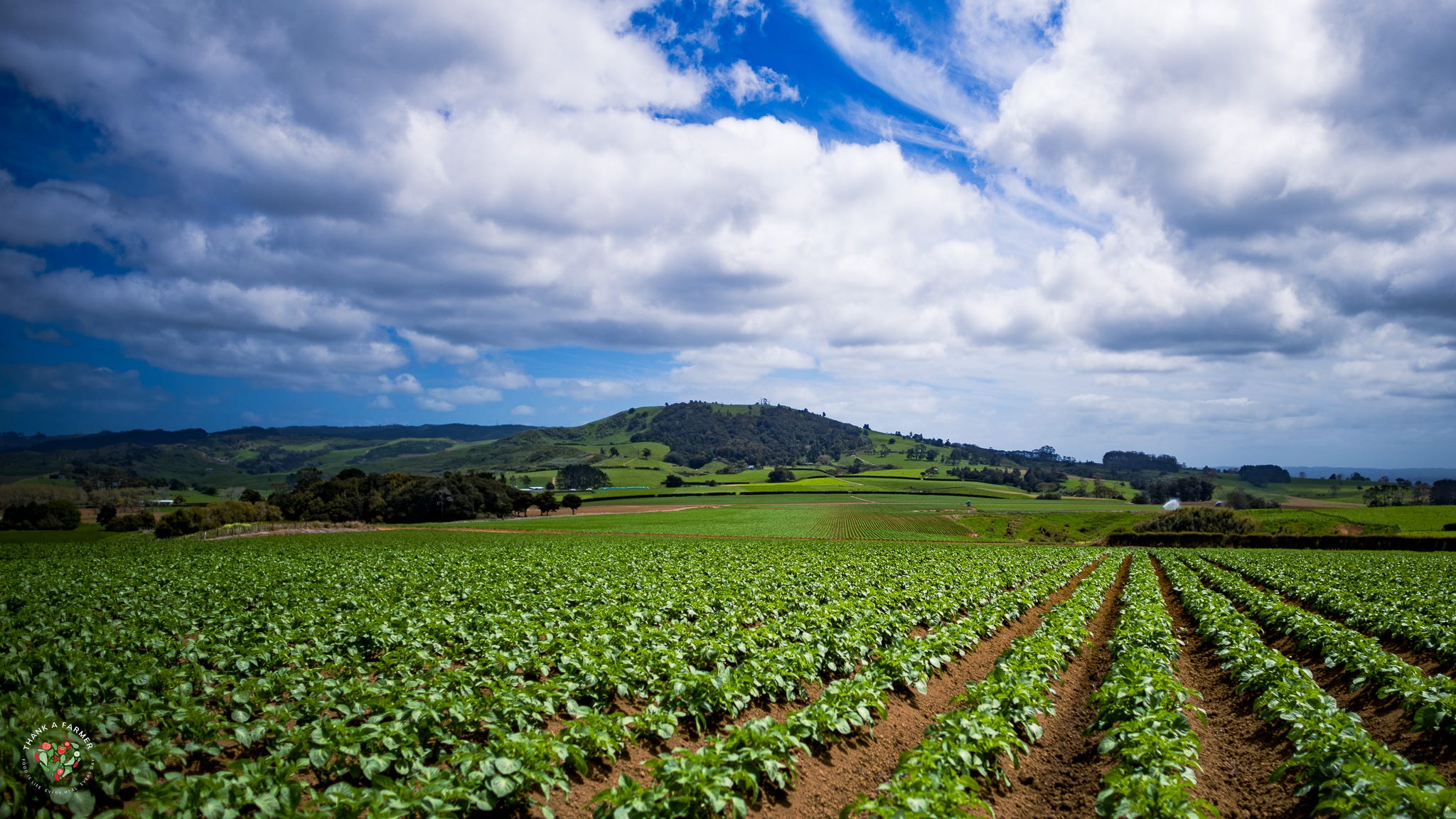
Potatoes: 176 growers in 2022/23, 151 in 2024/25. The area planted went up.
I still talk about the spring onions.
In the years after the auction wound down, and it didn’t end overnight, growers jostled with the supermarkets for space. The spring onion growers I knew were paid two ways for every crate. There was a price for the onions. Then there was a separate, itemised line for bunching them.
The bunching line went first. Almost overnight, it came off, and the crate’s value dropped with it.
The onions still went out bunched. Somebody still stood there tying them, crate after crate. The work didn’t go anywhere. The payment for it did.
There was no right or wrong in it. It was part and parcel of a change in how produce got from the paddock to the person buying it. Growers who could supply year-round lined up with Foodtown, Countdown and the rest, because they needed to secure the business. Growers who couldn’t were left to work out what came next.
One spring onion grower tried to win more of the business. He offered to bunch for nothing if he could supply more. He got the extra orders, then couldn’t fill them. The free bunching stayed anyway. From then on the itemised payment was gone, for him and for every other spring onion grower.
What stays with me is the itemised line. While the bunching had its own price, anyone could see what that work was worth. Once the line came off the paper, the work came off the record. It was still done every day. It just stopped being counted.
Ask a supermarket today, and I’m sure they’d say the price is more than enough to cover the bunching. Maybe it is. Nobody can check, because the bunching isn’t a line on anything anymore.
That’s the last twenty-five-plus years in one crate.
Horticulture New Zealand marked its twentieth year last December with a release that reads like good news, and a lot of it is. Horticulture has grown from 8% to 14% of primary sector exports. The total area under horticultural production has increased. In the same sentence, it says grower numbers “have consolidated from more than 7,000 in 2005 to around 4,300 today”.
That figure covers fruit and vegetables together, including kiwifruit and apples, and the release doesn’t say exactly what it counts. So I won’t stretch it. It does say there are about 2,700 fewer growers than twenty years ago, while the land under horticulture grew. Fewer people, more ground each.
Vegetables tell a harder version. Fresh Facts, the industry’s own annual report, uses Stats NZ census figures to put total vegetable area at 37,420 hectares in 2022, down a quarter from 49,707 hectares in 2012. Potatoes show what consolidation looks like up close. Over two seasons, the number of potato growers fell from 176 to 151, while the area planted rose from 8,424 hectares to 10,358. Same paddocks, more of them, in fewer hands. Onions have held at 75 growers for three seasons, down from 85 four years ago.
Those figures stop at the 2024/25 season. I know of at least five growers who have stopped growing onions this season. Growers are talking about it openly at industry events because they are hurting. That’s not a published count, and I won’t say who or where. Against 75, it’s one in fifteen gone, in a year.
Consolidation is the industry’s word, and it isn’t wrong. Bigger operations can build packhouses, cool stores and food safety systems a small grower never could. Some of those 2,700 sold up well, retired, or moved on to something better. Not every exit is a loss.
My read, after thirty-odd years in this industry, is that the 80/20 rule works well in potatoes, carrots, onions, leafy greens, and broccoli. A small number of operations carry most of the volume. I can’t prove that from published data, because nobody publishes how much of the crop the largest growers grow. I’m telling you what I’ve seen, and you can weigh it as such.
Which brings me to the number that matters most, and isn’t there.
A grower can be paid a fair-looking share of the shelf price and still go backwards. Share tells you how the dollar was split. It tells you nothing about what it cost to grow the food in the first place.
Contracts make that sharper. A reader who farmed arable land put it plainly in a comment on an earlier piece: the price is locked at signing, the costs move all season, and payment can come up to twelve months after harvest. The buyer gets certainty. The grower carries everything in between. Once a packhouse and a crew are built around one chain’s programme, that chain sets the terms, and the grower knows it. It’s the bunching line again, in a different shape. The cost is still there. It has just moved to the side of the ledger nobody reads.
Everyone accepts a supermarket needs a margin to stay in business and invest. Hardly anyone says the same about the grower.
Profit pays for the next tractor, the next variety trial, the irrigation upgrade, and years of patient work in the soil. A grower who breaks even doesn’t go under in a season. They stop investing. The gear gets older, the soil gets worked harder, and the daughter or son meant to take over looks at the books and takes a job in town. Nobody announces it.
So I went looking for whether growing vegetables in New Zealand still pays.
HortNZ’s own scorecard, the Aotearoa Horticulture Action Plan indicators for 2026, tracks certified growers (3,307 in 2024, 3,055 in 2025), certified hectares, farmgate value ($4.19 billion to $4.89 billion) and export value ($5.02 billion to $6.7 billion). Kiwifruit alone earned $3.66 billion in exports in 2024/25. Overall, our export growers are doing well, and their returns are on record. Fresh Facts publishes what a kiwifruit orchard returned per hectare every year: $136,342 in 2024/25. For onions, the same line has read “Not reported by industry” for three seasons. Every monetary figure in the scorecard is revenue. None of it tells you whether the growers feeding New Zealanders make a profit.
Being certified has its own price, and GAP is only one certificate among many. In 2024, HortNZ told a council hearing panel that domestic markets require more than 90% of the fresh fruit and vegetables New Zealanders eat to be GAP certified. A food safety audit runs from $1,000 to $4,500, depending on the size of the business, and the social and environmental add-ons are on top of that. Then comes the rest. In 2022, one grower walked RNZ through his: GAP auditors a couple of times a year at about $240 an hour, a building certification renewed every year, and a separate inspection for chemical storage. “There are just too many systems in place,” he said. That’s before the hours spent getting ready for each one.
None of that is wrong. Food safety matters, and I’ve done those audits myself. However, the buyer requires it, the grower pays it, and it doesn’t appear on anyone’s invoice.
It also leaves a question I can’t answer. If certification is the price at the door, what happens to the grower who can’t afford it, or chooses not to participate? Do they stop growing, or sell somewhere the certificate isn’t asked for? Nobody counts that either.
The Government does publish farm profitability for some farmers. MPI’s farm monitoring covers vineyards, with a 2025 Marlborough report, along with pipfruit, kiwifruit, beekeeping, and sheep and cattle. DairyNZ is on its twentieth annual economic survey of dairy farm businesses. Vegetable growers aren’t on MPI’s list.
The closest thing I could find is a model. In 2023, Perrin Ag built one for Auckland Council and HortNZ, to feed a freshwater planning tool. It put the average profit from a commercial vegetable rotation at about $3,740 a hectare a year. That’s roughly a tenth of what the crop brings in. The prices behind it were already a few seasons old.
Costs have climbed hard since. I’ve watched the price of a tractor roughly double in five years. Ask onion growers when they last made a profit and most will tell you it was three seasons ago.
Across the Tasman, growers can see the real thing. Australia’s Level Up Hort benchmark, funded through Hort Innovation, reports what vegetable and onion businesses actually earned, for the average grower, the top quarter and the bottom. For 2023-24, the average was A$4,233 a hectare. The least profitable lost A$8,522.
You can find out what a Marlborough vineyard made last year. You can find out what an Australian vegetable grower made. For a Pukekohe vegetable grower, the best you’ll get is a model built for a three-year-old water tool.
This isn’t one company's failure. It’s what the country has chosen to measure. The count gets published, and so do the hectares. The one figure that would tell you whether the growers who are left can keep going does not. That’s how growers can leave, season after season, without anyone having to answer for it.
Reciprocity is the test. When the supermarkets built direct supply, they asked growers for everything: volumes, quality, harvest dates, what was coming next week and next season. Growers gave it. Growers deserve the same courtesy, returned in one number, published every year. What it costs to grow our food, and whether the price covers it.
Foodstuffs is rightly proud of a third-generation grocer. I’d like to hear more about the third-generation growers and how many will hand it on to a fourth generation.
Think about the last vegetable you bought. Do you know who grew it? Will they still be growing it in ten years?
🌻
I work in key account management and business development for WestAg, a grower-owned reseller that supplies growers. My living depends on growers staying in business. That is part of why I care, and you should read what I write with that in mind. For more than thirty years I have told growers what is best for them, even when the company I worked for didn’t sell it. Hold me to that standard here too.
Thank a Farmer. Food is Life - Every Meal - Every Day.

Sources
Horticulture New Zealand, “HortNZ marks 20 years supporting one of New Zealand’s fastest-growing sectors”, media release, 10 December 2025. https://www.hortnz.co.nz/news-events-and-media/media-releases/hortnz-marks-20-years-supporting-one-of-new-zealands-fastest-growing-sectors
Horticulture New Zealand, Aotearoa Horticulture Action Plan indicators 2026. https://www.hortnz.co.nz/assets/About-Us/Aotearoa-Horticulture-Action-Plan/Aotearoa-Horticulture-Action-Plan-indicators-2026.pdf
United Fresh New Zealand, Fresh Facts 2025: vegetable area by region, Stats NZ Agricultural Production Census, year ended 30 June 2022 (pp. 56-57). Potatoes, from Potatoes New Zealand (p. 22). Onions, from Onions New Zealand (p. 18).
Horticulture New Zealand, fact sheet for the Timaru District Council hearing panel re GAP certification in the horticulture industry, version 3, July 2024. https://www.timaru.govt.nz/__data/assets/pdf_file/0019/910009/Sub245-HortNZ-Hearing-B-Fact-sheet-for-Hearing-Panel-re-GAP-certification-in-horticulture-industry-July-2024.pdf
RNZ, “Unviable to grow produce in NZ: farmers blame rising cost of energy, rates, wages, audits”, 10 March 2022 (Roelf Schreuder, NZ Gourmet). https://www.rnz.co.nz/news/country/463086/unviable-to-grow-produce-in-nz-farmers-blame-rising-cost-of-energy-rates-wages-audits
Ministry for Primary Industries, Farm monitoring. https://www.mpi.govt.nz/news-and-resources/economic-intelligence-unit/farm-monitoring/
DairyNZ, DairyNZ Economic Survey 2024-25. https://www.dairynz.co.nz/resources/resource-list/dairynz-economic-survey-2024-25/
Perrin Ag Consultants, Horticulture Typology Modelling for the FWMT, prepared for Auckland Council and Horticulture New Zealand, May 2023 (executive summary p. 6, Table 50 p. 81). https://aucklanddesignmanual.co.nz/content/dam/adm/adm-website/developing-infrastructure/freshwater-management--tool/supporting-model/Horticulture-Typology-Modelling-for-the-FWMT.pdf
Level Up Hort Vegetable and Onion Benchmark 2023-24 (Hort Innovation, delivered by Planfarm and RMCG), as reported in Country News, 4 July 2025. https://www.countrynews.com.au/horticulture/vegetable-growers-face-ongoing-squeeze/