
Every Answer Is Why It Cannot Be Done
New Zealand has not imported a new pear variety in twenty-six years.

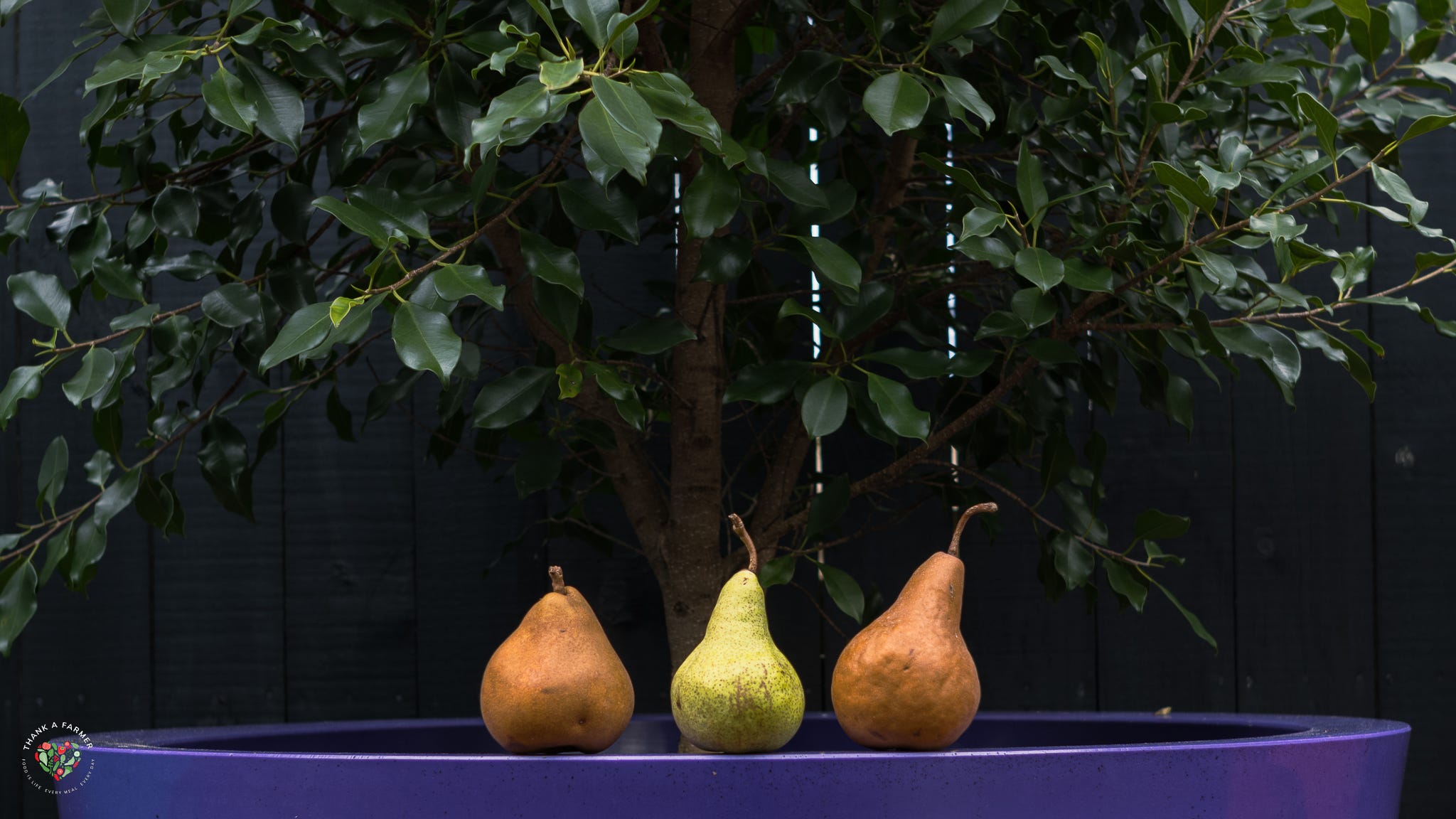
Three pears, and nothing newer. Two of the varieties New Zealand grows commercially were bred while Victoria was on the throne. It has been twenty-six years since a new one arrived.
New Zealand has not imported a new pear variety in twenty-six years. Last year it proposed suspending imports of another 1,468 plant genera and species. Mango, olive, persimmon, garlic and walnut among them. The test was whether anything had been imported in the past eleven years. We are being told artificial intelligence will sort it out.
Fifteen months ago Cabinet endorsed all sixteen recommendations of the review into how New Zealand approves agricultural chemicals. Two Bills amending the HSNO and ACVM Acts sit before a select committee now. The EPA publishes quarterly performance reports. Biosecurity New Zealand has a reform programme running on plant imports.
I have written about all of it.
In that time, not one grower I know has told me that anything arrived!
That gap is what sent me back to the reading. Farmers Weekly on import costs. The coalition that took its concerns to the Minister in July. Paul Paynter on pears. Chris Claridge on quarantine. Story after story saying the same thing in slightly different words, and underneath all of them a phrase I had never properly looked at.
Import health standard.
Every piece of plant material used to grow and breed new varieties, every new crop, every piece of plant material this country might use to grow something it cannot currently grow, arrives through one of these. No standard, no plant. And the Government and the horticulture sector have a joint target of twelve billion dollars in horticultural exports by 2035.
So over the last week I sat down with the document itself. Import Health Standard 155.02.06, Plants for Planting, issued under the Biosecurity Act, in force since the fifth of November last year. Five hundred and twenty-three pages. Almost nobody outside the nursery trade has read it.
Turn to page 349.
Entry 3.131 is Pyrus. Pears. Approved commodities, dormant cuttings. Suspended species, all.
The rest of the box is empty.
Now turn back to page 267. Entry 3.103 is Malus. Apples.
Dormant cuttings and tissue cultures. Three graded routes in for cuttings alone, running from six months in quarantine to twenty-four, depending on how much work was done offshore first.
Same family. Same fruit type. Frequently the same orchard, sometimes the same row. One has a working pathway with three ways through it. The other has an empty box.
I have spent the last week trying to understand how that happened. What I found is not really about pears at all.
Follow one crop all the way down
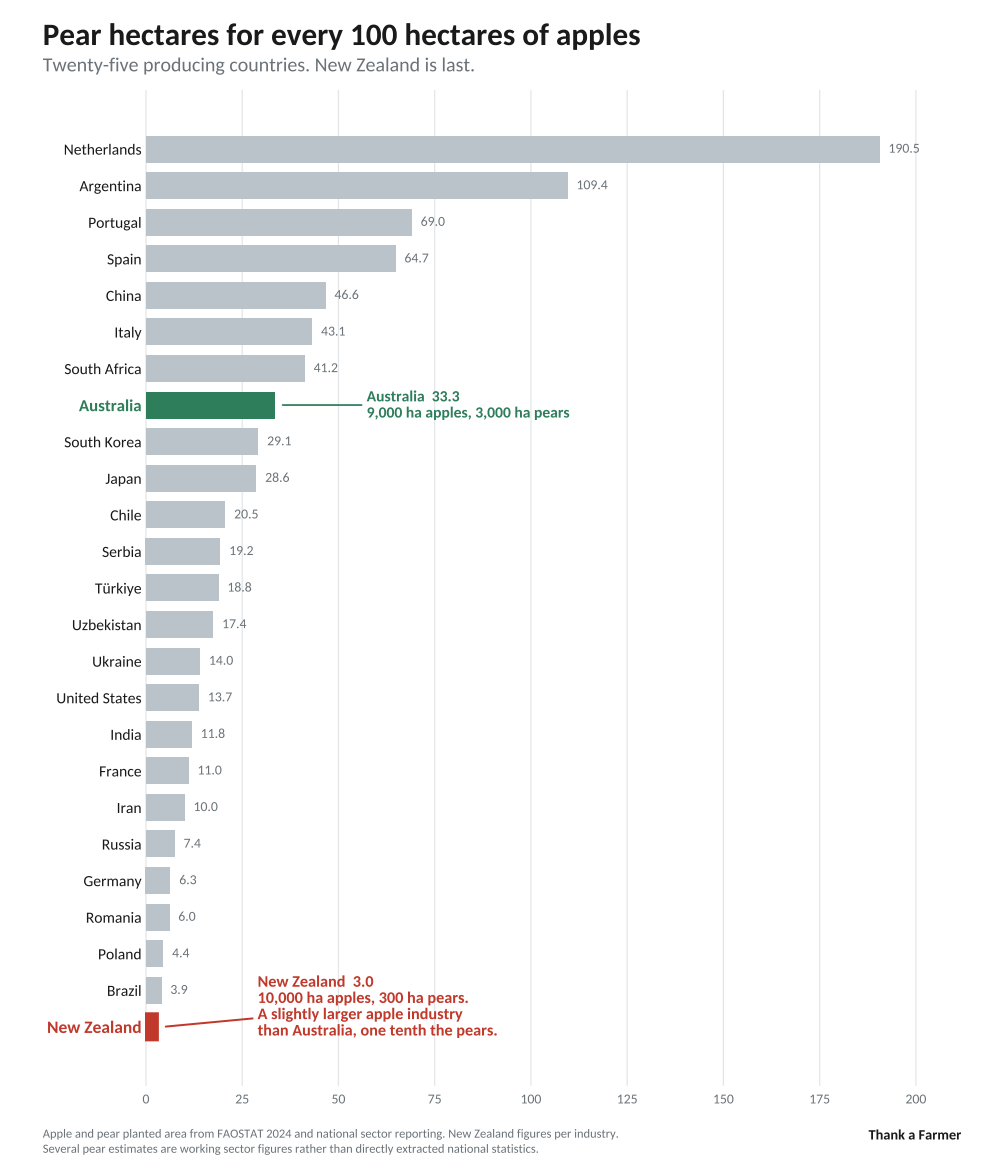
Start with pears, because it is the one crop where every link in the chain can be proved. New Zealand grows about 300 hectares of pears against more than 10,000 hectares of apples. I put that beside twenty-four other producing countries.
We are last. Twenty-fifth of twenty-five. Three hectares of pears for every hundred hectares of apples. Nobody measured is lower.
Industry had that comparison on paper two years before I did. In its August 2024 submission, BLOOMZ New Zealand listed the fifty-six genera where the highest level of post-entry quarantine is compulsory. Only thirteen could be imported at all without first needing an assessment, a review, or a standard that did not exist.
Apple is one of the thirteen. Against pears, the table carries two words. Review prioritised. It had been prioritised since 2021.
Paul Paynter of the Yummy Fruit Company gave Farmers Weekly the reason last week.
“A big part of the reason is because we have not had a new pear variety planted in NZ for years. We are stuck with two old Victoria varieties.”
He said for years. The number is twenty-six.
Not a slow trickle. Not one or two. None.
Then he tied it to the target.
“If NZ is to double its exports, and this fruit would be capable of doing that, we need to do it with something more innovative than fruit from the Victorian era.”
He blamed the absence of an import health standard for pears, and called that absurd.
He is close, and the truth is worse than the version he was given. There is a standard for pears. I have just read it. It is one commodity wide, and every species inside it is suspended.
An absent standard is an oversight. A standard with nothing left in it is a decision that nobody had to make.
The comparison that should stop a Minister mid-sentence is Australia. Nine thousand hectares of apples, a smaller apple industry than ours. Three thousand hectares of pears.
Ten times the pear area, on a smaller apple base. Same hemisphere. Same export windows. A biosecurity reputation at least as fierce as ours.
Australia breeds its own as well. Lanya and Deliza, now sold as Ricó, came out of the national pear breeding programme at Tatura in Victoria. Both are deliberate crosses made in 1995, using imported parent material. Ricó stores for ten months under controlled atmosphere.
The most recent new European pear to reach New Zealand was Taylor’s Gold, in 1985. It was not bred, and it was not imported. A man near Nelson noticed a mutation on a branch and had the sense to propagate it.
That is our varietal strategy for European pears. Somebody walked past a tree forty years ago and looked up.
We can breed. PIQA® Red, a New Zealand, bred variety, is an interspecific cross of European, Japanese and Chinese material from the Plant and Food Research programme Dr Alan White began in the 1980s. It is licensed, commercial, and grown in Australia. But a breeding programme is a machine for recombining what it already has. Its parents came into this country decades ago. Nothing has come in since. We built the capability and then cut off its fuel supply.
Meanwhile, there is a variety called QTee®, sold as Celina, first planted in Belgium in 2015. It is now licensed in fifteen countries. Norway. Morocco. Slovakia. South Africa. Australia, where it debuted in January last year. Around eight hundred hectares worldwide, about fifty hectares per country. Scale was never the entry requirement.
New Zealand growers know about QTee®. They can name it. Some have stood in orchards overseas and eaten it. Growers who have enquired more than once about bringing pear material in report being told the same thing. A pear import health standard would take at least five years.
So nobody applies. Nothing is refused. There is no file anywhere in Wellington. You cannot licence a variety you have never been allowed to evaluate. The trial block comes first. Always. And here the trial block is illegal.
Now the part that is not about pears
The proposal put out for consultation in July 2024 covered 1,468 genera, species, and commodities. It did not include pathways already suspended, such as pear. It did not include the ones that never existed, such as pine.
The test for closing a pathway was a single line. The date of last import is more than eleven years ago.
Eleven years without an order. Not risk. Not science. Not a pest anyone had found. Whether a New Zealand business had bought something recently enough.
Amendment 93 of the standard, dated 4 August last year, records what followed.
“Suspension of import pathways that are not fit-for-purpose. Amendment to the entire standard to change the format to be more user-friendly and rename the standard from Importation of Nursery Stock 155.02.06 to Plants for Planting 155.02.06.”
Not fit-for-purpose. Their words. The requirements had decayed past use, so the pathways were shut, and the same amendment gave the document a friendlier name.
What survived sits at the back of the standard, five pages of three-column small type. Roughly seven hundred and sixty genera that “are currently suspended and are not eligible for import”, plus another sixty-one closed in whole or part.
Read the named crops as a menu, not a list.
Jackfruit. Papaya. Yam. Persimmon. Loquat. Wasabi. Walnut. Lychee. Mango. Banana. Olive. Pecan. Blackcurrant. Asparagus. Garlic and onion. Passionfruit. Pear.
Every one of those is a crop somebody in this country could have been growing, or growing better.
Ten of those are subtropical, tropical or Mediterranean crops.
New Zealand is warming. Northland, the Bay of Plenty, Gisborne and Hawke’s Bay are moving into conditions where those crops start to make sense. A changing climate offers a food-producing country very little that is good. A wider range of things we can grow is one of the few items on that list.
Some of those are suspended because of real, unmanaged pest risk. Some would never pay their way here whatever the temperature does. Blackcurrant is a cold crop, and it sits on the list too, so this is not the whole explanation.
It is still a fair question, and I would like it answered. Of everything we have closed the door on, how much of it is what a warming New Zealand would most want to test?
They asked. By name. With the numbers attached.
On 30 August 2024, BLOOMZ New Zealand made a submission on behalf of most of the people who actually use this system. The Fruit Tree Importers Group. T&G Global. The Persimmon Industry Council. Prevar, which commercialises our own genetics. They made two points that are hard to read twice.
The first is that these pathways were not idle because nobody wanted them. The submission lists the crops the industry had formally asked the Ministry to review, and the year of asking. Jackfruit in 2011. Walnut, olive, garlic, banana, hazelnut and sweet potato in 2019. Garlic, kumara, banana, olive and mango again in 2021. Everyone appeared on the 2024 list to be suspended for lack of use.
“Importers are aware pathways are out-of-date, but given the backlogs with IHS assessment, amendment and development, requests for IHS reviews or permit applications aren’t made as there is little confidence they will proceed.”
That is the five years for pears, written down two years early.
The second point is the one that stayed with me. They asked for four crops to be spared, by name, with the economics written out.
Garlic. An industry worth ten to twenty-five million dollars, losing five to ten million if new material cannot come in, because virus levels rise and yields fall while imports from the United States and China do not.
Persimmon. Ten million dollars a year in exports, ninety-five per cent of it grown in Tairāwhiti and Northland, the whole industry standing on one variety. Fuyu.
Passionfruit, at over five hundred thousand dollars a hectare, needing new rootstocks because fungal disease kills the plants. And Paulownia, for timber, shelter and roots that hold a hillside together.
Seven months later, Biosecurity New Zealand answered.
Three hundred genera were reopened. Another forty-five went into an appendix under a heading that could not be clearer.
“The following table includes the pathways which will not be suspended but require further work to appropriately manage biosecurity risk.”
Four of those forty-five were Allium, Diospyros, Olea and Passiflora. Garlic. Persimmon. Olive. Passionfruit. Three of the four they had asked for by name.
Now read amendment 95 in the standard now in force.
“Suspension of species in the following genera: Allium, Diospyros, Olea and Passiflora.” Sixth of October last year.
Fourteen months from the submission to the suspension. Seven from the promise.
I do not think anyone set out to break their word. The analysis was needed, the analysis did not happen, and the pathway closed by default. That is worse than a broken promise. A broken promise implies somebody decided.
About three hundred pathways were spared. Every one of this group that had asked to be kept was closed.
The number that explains everything
Andrew Hoggard, the Minister for Biosecurity, has told growers in public meetings that the risk assessment behind a single import health standard takes between eight thousand and fifteen thousand hours. New Zealand’s largest plant importer has confirmed that figure to me independently.
If that number is wrong, it should be corrected. The correct one should then be published, because as far as I can find, no such figure exists anywhere in public.
Take it at face value.
A full-time year is about eighteen hundred working hours once you take out leave. So one standard is somewhere between four and eight full-time years of assessment work.
Put ten people on it, and they will finish one or two a year.
One thousand four hundred and sixty-eight were proposed for closure.
You do not need the rest of the arithmetic. At that rate, the closed list outlives everyone reading this.
Five years ago, Cabinet approved $29.5 million over four years, specifically for risk assessment, import health standard reviews, and developing new systems.
The submitters, watching it closely, say the pace did not lift. One or two completed a year. Farmers Weekly reported last week that two new standards have been completed in five years. Both counts are small enough that the difference between them does not matter.
I went looking for the reconciliation. Standards started. Standards finished. Spend against appropriation. A forward schedule with dates. I could not find it published anywhere. I am not saying it does not exist inside the building. I am saying a grower who paid for it cannot pick it up.
The Minister was not making an admission when he gave that number. He was explaining. This is why it takes so long. This is the scale of the work. Offered in good faith, as context.
Read properly, it is not an explanation. It is the diagnosis. Eight to fifteen thousand hours per unit is why this can never catch up, at any funding level a government would plausibly approve. Double the team, and you halve a number that is already measured in lifetimes.
The constraint was described out loud, and nobody in the room appears to have noticed it was fatal.
How the doors actually closed
Biosecurity New Zealand wrote it down themselves, in that same review of submissions. Their words are better than mine.
Importers told them, and MPI gave the section this heading. “No recent trade does not reflect disinterest in the pathway.”
The submissions said pathways were unused “because the current import requirements are too difficult to meet.”
MPI’s response. “We understand that some pathways are desired but are difficult to use. Unfortunately, because these pathways have not been used, they have not been maintained.”
And then. “Many of the pathways that will be suspended have not been maintained because they have not been used in many years.”
Too expensive to use. Therefore unused. Therefore unmaintained. Therefore closed.
MPI’s advice to anyone who wants a suspended pathway back is to request an import health standard review.
The same review that takes eight to fifteen thousand hours. In the same document, MPI records, and does not dispute, that pathways prioritised for review in 2021 were still pending in 2025 - And still pending now
None of this is new. The same finding was written up in 2006, and again in 2014. Both papers were called Barriers to importation. The 2024 submission is the third telling.
“The same issues have plagued importers for nearly 20 years and require rapid and bold action. While these remain unresolved, to suggest doubling of exports any time soon is simply wishful thinking.”
That was written to the Ministry twenty-four months ago.
One more thing about those 523 pages. The genera that received a properly reviewed standard in recent years are not in there. They moved out into standards of their own. What is left is largely what has not been reviewed.
The document is not a catalogue of what we import. It is the backlog, written down.
We cannot breed our way out of this
There is an answer to this that sounds reasonable until you check it. If overseas genetics are hard to get, breed our own. So, the submission went to the Intellectual Property Office and pulled the Plant Variety Rights held for our top ten horticultural export crops, which are ninety per cent of horticultural export value.
Sixty-six per cent of the Plant Variety Rights already granted for varieties of New Zealand’s top ten horticultural export crops are held by offshore breeders. Among applications still being processed, that figure rises to 86 per cent. Overall, 73 per cent of rights are offshore-owned, and the newer the variety, the more likely it is to have been bred overseas.
Three quarters of the varietal base under our biggest export crops was bred somewhere else. That is not a failure of New Zealand science. It is how plant breeding works everywhere, in clusters, by crop. It does mean the door is not optional.
Then there is the fifteen million dollars. The submission lists government grants paid into the very crops whose pathways were proposed for closure. A robotic asparagus harvester. Persimmon after the cyclones. Macadamia on Māori land at Tōrere and Waihau Bay. Olive oil. Kumara. Truffles. Mānuka and kānuka across Te Taitokerau and Ngāti Porou country.
Fifteen million, one hundred and three thousand, four hundred and two dollars.
One arm of government investing in the crop. Another closing the door on its genetics. Nobody in either arm doing anything other than their job.
And now we are told a computer will fix it
Biosecurity New Zealand has confirmed a work programme exploring whether artificial intelligence can significantly reduce the time it takes to develop import standards, without compromising biosecurity.
It may well help. Literature searching, pest-list assembly, first-pass drafting, translating an overseas dossier into our format. Those are real hours, and software is good at them.
An import health standard is not a typing job. It is pest-by-pest risk analysis, a judgement about what New Zealand is willing to accept, and a signature that carries legal and career consequences if something gets through. Artificial intelligence can compress the search. It cannot carry the liability. It cannot decide the country’s risk appetite.
By how much, by when, and measured against what published baseline?
Halve the assessment time, which is a heroic assumption, and the closed list still outlasts the careers of everyone now working on it.
This is the pattern I have been writing about for months, arriving in a new costume.
The EPA reports deciding more applications than were lodged for five consecutive quarters, and offers it as an achievement. Reform is underway. Consultation is proceeding. A new facility is coming. Artificial intelligence is being explored.
Every one of those statements is true. Not one of them is a delivery.
They arrive as reassurance, and their effect, whether anyone intends it or not, is to make structural change feel unnecessary. That is the ride New Zealand is being taken on. Not lies. A steady supply of reasons why the problem is in hand, offered by people who mostly believe it.
We already know what works. We are already doing it.
Potatoes New Zealand could not use the domestic pathway, so they went offshore, to an accredited quarantine facility in Scotland.
Biosecurity New Zealand’s deputy director-general, Stuart Anderson, has said on the record that this model could be replicated for other plant types if the biosecurity measures are met.
He has also confirmed that six overseas facilities are already assessed as demonstrably equivalent to ours, with agreements worked through case by case. The assessment exists. The equivalence exists. What does not exist is a default, so every importer pays again even if nothing has changed at the facility. All for a conclusion the Crown has already reached.
That is not an AI problem. Nothing in it is waiting on software, a building, or 2029. It is a decision, and it could be made on Monday.
Credit, and then the ask
Andrew Hoggard has not hidden from any of this. He has said plainly that the system has major problems and that he is trying to fix them. I would rather have a Minister who says that than a press release.
Biosecurity New Zealand opened a new post-entry quarantine facility in March 2025. It ran workshops. It reformatted the standard. It reopened three hundred genera when importers asked. Its people are careful public servants working under real legal liability, and I would not want to sign one of those assessments either.
None of that is nothing. However, intent has never been the constraint, and it is not the constraint now.
So, four things. None of them requires new legislation.
Publish the receipt. How many FTEs have been employed to specifically improve delivery of IHSs for high-value horticulture? One page. What the $29.5 million bought. Standards started, completed, in progress. Spend to date. A forward schedule with dates.
Fix the audit, not the list. The six approved offshore facilities are published, and so is the standard they are measured against. Getting audited is the problem. Operators report around eighteen months to receive a report and an agreement, at costs unrelated to the work, against requirements that move depending on who is reading the standard that day. Put a clock on it. Publish the average time, the average cost, and how many facilities are waiting. Give an applicant a way to challenge a demand that is not written down.
Replicate the Potatoes New Zealand model as a published pathway. Biosecurity New Zealand has already agreed it can be done. Write it up and open it.
Publish the real hours, and the plan against them. If eight to fifteen thousand is wrong, correct it. If it is right, say how many of those seven hundred and sixty genera will reopen in the next ten years, and let the country see the arithmetic for itself.
We have a joint government and industry target of twelve billion dollars in horticultural exports by 2035.
We are pouring the foundations of a half-billion-dollar biosecurity facility that opens in 2029.
And for twenty-five years, New Zealand science has been helping breed pears for hot climates. The programme runs with Spain. Two of its four partners are New Zealand organisations. The germplasm sits in Catalonia and cannot come home.
Twenty-six years without a new pear variety.
One thousand four hundred and sixty-eight more doors proposed for closing, and the ones already bolted, pear among them, were never even counted.
I do not believe anybody chose this. I believe a great many capable people each did exactly what was asked of them, and this is the sum.
We are past the point where good intentions and a work programme count as an answer.
Delay is not caution. It is its own form of risk.
Open the doors.
Thank a Farmer - Food is Life, Every Meal, Every Day.

Sources
MPI, Import Health Standard: Plants for Planting 155.02.06, in force 5 November 2025, 523 pages. Clause 1.1(1)(a). Part 3 entries 3.103 (Malus) and 3.131 (Pyrus). Appendix 2 Amendment Record, amendments 80 of 16 October 2023, 93 of 4 August 2025 and 95 of 6 October 2025. Appendix 6, pages 519 to 523. MPI Live Plants Team, Review of Submissions, Importation of Nursery Stock 155.02.06, March 2025, pages 4 to 6 and the appendix of pathways requiring further review, covering the consultation of 18 July to 30 August 2024. Richard Rennie, “Biosecurity bottleneck chokes plant imports,” Farmers Weekly, 3 September 2025, for Stuart Anderson on six equivalent overseas facilities and the AI work programme. Richard Rennie, “Quarantine centre slammed as white elephant,” Farmers Weekly, 10 September 2025, for the Mt Albert facility, Chris Claridge on the UK Potato Quarantine Unit, Anderson on replicating the offshore model, and Hoggard on the system’s problems. Richard Rennie, “Minister shares growers’ concerns on plant approvals,” Farmers Weekly, 10 August 2026, for the $29.5 million appropriation, the two completed standards, and Paul Paynter on pear hectares, the two old Victoria varieties and fruit from the Victorian era. Apple and pear area from FAOSTAT 2024 and national sector reporting across 25 countries, with New Zealand figures per industry. QTee and Celina licensing from Fruitnet, FreshPlaza and FreshFruitPortal, 2022 to 2025. Australian National Pear Breeding Program from APAL, Hort Innovation AP12002, and USPTO plant patents PP25741 and PP25742. Piqa Boo from Plant and Food Research and Prevar. Hot Climate Partnership from hotclimatepartnership.com. EPA hazardous substances quarterly performance report, March 2026. Hours per import health standard from Hon Andrew Hoggard in public meetings with growers, confirmed independently to the author.BLOOMZ New Zealand Limited, Submission on proposed changes to the import health standard 155.02.06: Importation of Nursery Stock, 30 August 2024, submitted on behalf of the Fruit Tree Importers Group, Murphy’s New Zealand, New Zealand China Fruit Company, the Persimmon Industry Council and Prevar. That submission is the source for the 1,468 genera and 314 commodity pathways, the eleven-year criterion, the record of review requests from 2011 onward, the crop-by-crop case for garlic, persimmon, passionfruit and Paulownia, the Level 3B post-entry quarantine table, the Plant Variety Rights statistics from IPONZ at 20 June 2024, and the schedule of government co-investment. Nikki Johnson, Barriers to importation of new plant species, Plant Imports Action Group, 2006, and Barriers to importation of new germplasm, Germplasm Advisory Committee, 2014. Government and horticulture sector target of $12 billion in exports by 2035, Beehive release.
A few people have asked what I actually think the fix is. Humbly, let me put it plainly.
It is not more funding. The $29.5 million is the evidence.
It is not artificial intelligence. That might shave hours off a task that takes eight to fifteen thousand of them.
It is not waiting for a new Biosecurity Act. Industry has been waiting nearly twenty years already.
The only thing that changes the trajectory is collaboration. Real collaboration, with the people who use the system, before the decisions are made rather than after.
And I want to head off the objection I know is coming, because it is the one that has killed this idea every time it has been raised.
Collaboration is not sharing intellectual property.
Nobody is asking MPI to hand anything over. Nobody in industry is offering up their varieties, their breeding programmes, or their commercial dossiers.
What industry holds is something different. Crop-specific pest knowledge sitting with people who have grown that crop for thirty years. Agronomy. Practical experience of offshore facilities and what actually works inside them. Knowledge of which pathways matter commercially and which genuinely are dead. Sight of risk assessments already completed by regulators we have every reason to trust.
That is not intellectual property. That is capability sitting outside the building, unused, while a queue that would take generations to clear sits inside it.
The submitters said this two years ago, and in almost these words. A radical new approach to import health standard development, with early collaboration with industry, is the number one priority. Group genera by risk profile instead of grinding through them one at a time. Cooperate on risk assessment with industry crop specialists and Crown Research Institutes. Look at Australia, which is reviewing import conditions right now for banana, pipfruit, mango, hazelnut, pomegranate, sugarcane and sweet potato.
Every one of those is a crop we have closed.
Biosecurity New Zealand has also said, on the record, that no commercially sensitive information was required in its workshops. So the confidentiality argument does not hold either.
This is not about lowering the standard. It is about who is allowed to help meet it.
We have a target of twelve billion dollars in horticultural exports by 2035, and a system that cannot open a door inside a generation. Both cannot be true at once.
Future-proofing New Zealand's food and fibre sector, and NZ Inc with it, will not be done by one agency working alone behind a wall. It never was going to be.
Let the people who use the system help build it.
🌻
Another clear, fact-exposing and much-needed hard-hitting article Fenton.
You have once again done an excellent job of exposing the core issues behind what, on the surface, looked like a bottleneck — and, importantly, identifying practical solutions to start to address what has become an archaic, gradual decline and erosion of our multigenerational growing industry.
Putting politics aside, surely there are now enough people, both within and outside the growing community, reading and understanding this information to recognise that something has to change, and change quickly.
The solutions you outline are not beyond the people who work within these systems, and if the people on the ground are part of the solutions their combined knowledge could turn this around. It's one thing having a target of 12 billion dollars in horticultural exports by 2035, however there needs to be a clear HOW and MEASURES along the way so assessments can be made and progress can be tracked?
New Zealand has built an incredibly successful horticultural industry over generations. We should not allow bureaucracy, outdated systems and institutional inertia to slowly dismantle it.
There is still time to turn this around — but we need to action before it is really TOO LATE.